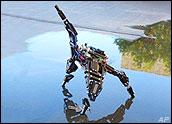
Cornell University researchers have created a robot capable of self-awareness, learning and adapting — all keys to the intelligence and technology needed for robots to function in adverse and changing environments.
The Cornell researchers, who published their findings in the Nov. 17, 2006, issue of Science, said their robot did not rely onpredetermined models of movement in order to learn how to walk on its four legs. When the researchers removed one of the legs, the machine was able to adjust for the difference and eventually walk on three legs.
“We found a way the robot can generate its own model,” Cornell assistant professor and lead researcher Hod Lipson told TechNewsWorld.”It allows the robot to develop [an] internal model and to make predictions. That’s the core of the idea.”
Smart Starfish
The robot, dubbed “Starfish” because of its size and shape, is programmed to recognize its parts but does not know how they are arranged or how to use them. The device is also programmed with a prime directive to move forward, researchers reported.
It uses trial and error, building a random series of “candidate models” of how its parts might be arranged in order to move. Itdevelops a set of commands to send to its motors, tests those models, and then moves ahead.
Starfish is made from printed plastic and runs Windows XP Embedded, Lipson said. It communicates wirelessly with a bank of 15 desktop computers. In a few years, the number of processor cores and other advances will allow such a system to reside in the robot, he added.
Changing the Model
There are two basic ways of designing robots. There is the predictive model, which gives the robot a control system based on engineering design; and then there is the method used to create Starfish. In the latter case, the robot learns and determines control, according to Lipson, who worked on Starfish with Cornell graduate student Viktor Zykov and former Cornell postdoctoral researcher Josh Bongard.
While endless trial and error can be a challenge, Starfish can crunch its different candidate models, reconciling and comparing themuntil they converge, Lipson said.
“It will allow robotics to move to systems where it’s difficult to create analytical models,” he said, referring to thecomplex and laborious task of programming for sophisticated, real-world scenarios.
Possible applications of the technology include the use of robots in space or other distant or harsh environments. It may also have uses beyond robotics in fieldsof study such as human and animal behavior and learning, the Cornell researchers said.
Important First Steps
The self-learned steps of Starfish demonstrate the importance of self-awareness and self-repair functionality in robots, Eyebits Studios Owner Dale Musser told TechNewsWorld.
The Cornell research and similar efforts are also important in order to understand the macro scale, so they can be applied to the nano scale where self-assembly is key in tiny or microscopic devices, explained Musser, a robotics enthusiast and former University of Missouri professor.
“The important thing about self-awareness is you have to take steps to get started,” he said of the Cornell research.

















 Loading ...