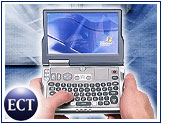
The idea of the Windows desktop PC in a small, mobile form is nothing new, and judging by the amount of notebook sales to consumers, the mobile form factor is in high demand. But the latest approach to the mini PC — on display at this week’s DEMO 2004 trade show in Seattle — has the endorsement of Microsoft co-founder and tech heavyweight Paul Allen.
Analysts are mixed on the mini PC space and the new device itself, dubbed the FlipStart, which looks like a personal digital assistant (PDA) with a small display and thumb keyboard. However, it does seem to represent another step forward in the trajectory that is moving toward a real Windows PC experience in a very small mobile device, at least according to Gartner research vice president Martin Reynolds.
“Bottom line — this form factor could be a big winner, converging PCs, handhelds and tablet technology,” Reynolds told TechNewsWorld. “It also suggests that one day we could have cell phone-sized devices with this capability.”
Porting the PC
The Windows XP-powered device, weighing 1 pound and sized at 5.8 inches by 4 inches by 1 inch, features a 1-GHz processor, 256 MB of RAM, a 30-GB hard drive, a 5.6-inch 1024 x 600 pixel display and a lithium ion battery that will run the device for two to six hours of use.
The company said that with integrated 802.11b wireless capability, the FlipStart combines the performance and functionality of Windows XP with the connectivity of wireless PDAs to provide continuous, mobile access to software, e-mail and the Web.
Analysts have praised the mini PC for its ability to use desktop PC software without the need for special mobile viewers or emulator applications.
“These systems fit all existing infrastructures and make it easy to port corporate apps into the handheld environment,” Reynolds said. “It has most of the portability of a PDA but can do serious computing.”
Lost in Translation
IDC smart handheld devices analyst Alex Slawsby said handheld-size PCs are nothing new — with other versions already out in the form of the Tiqit83 and OQO’s Ultra Personal Computer. While bringing a full version of Windows XP into the small form factor could pique consumer interest, Slawsby cautioned that the XP experience might be better tuned to a larger system.
While there is worldwide familiarity and fondness for the Windows PC experience, Slawsby said, it is difficult to replicate the experience in a smaller device with mobile constraints on size, battery life and heat.
“The idea is to give you all the functionality you would want in the desktop or laptop in a mobile environment without sacrificing anything,” he said. “But part of the PC experience is a larger screen, a mouse and a keyboard; the same thing goes for laptops.
“You may be able to put XP on small hardware, but you don’t have the ability to leverage the same input capabilities,” Slawsby added.
Paul Allen’s Pet
Reynolds said the biggest challenge for the handheld-size PC is to make it good enough for day-to-day work without the need for a sophisticated dock that stays at home or in the office.
Slawsby, who said the FlipStart is getting attention in particular because of its backing from Paul Allen, indicated there are still questions about the price of such a device and its true ease-of-use and desktop-like interactivity.
Vulcan spokesperson Michael Nank told TechNewsWorld that the company will be announcing more on distribution and pricing for the FlipStart device, which should be priced comparable to a midrange notebook computer. While he would not offer a timeline for those announcements, Nank did indicate the project is something Paul Allen believes will be embraced by users.
“This is really something being driven by Paul G. Allen and his interest in technology,” Nank said.












 Loading ...