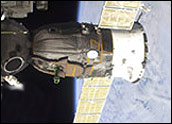
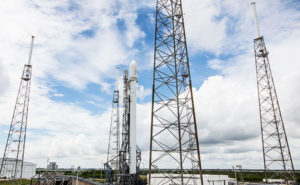
NASA launch crews were making final preparations Monday for this week’s launch of the space shuttle Atlantis, which will install the European Columbus science laboratory on the international space station (ISS).
Mission STS-122 is slated to lift off at 4:31 p.m. EST Thursday from Launch Pad 39A at NASA’s Kennedy Space Center. Countdown is scheduled to begin Monday at 7 p.m., and weather forecasts indicate an 80 percent chance of favorable conditions, weather officer Kathy Winters said.
The seven astronauts who will fly Atlantis into orbit are due to arrive at Kennedy’s Shuttle Landing Facility on Monday, and they will stay at the spaceport until launch day. The mission will be NASA’s 24th flight to the ISS.
22,700 Pounds
After 25 years in the making, the European Space Agency’s (ESA’s) Columbus lab is a cylindrical structure, 23 feet long and 15 feet in diameter, that promises to double the research capacity of the ISS. It has a mass of more than 22,700 pounds and a volume of 2,648 cubic feet, and is full of wiring and plumbing for life support systems.
The laboratory will hold 10 racks of experiments, each about the size of a phone booth. Its experiments will focus on examining how humans react to microgravity and the effect of space on various fluids and objects.
“This is, for us, the opportunity to have long-term access [to space],” said Gregor Woop, product assurance manager for ESA. “It provides an opportunity for science institutes to send experiments on board and to run experiments.”
Columbus will join NASA’s Destiny lab, which was taken into orbit in 2001. Next year, a series of space shuttle missions will carry the components of a Japanese laboratory into orbit. When the international space station is complete, it will have a mass of almost 1 million pounds and be larger than a five-bedroom house.
Three Spacewalks
Installing the Columbus lab will involve a series of spacewalks and maneuvers with robotic arms during the shuttle’s 11-day mission. In the first space walk, which will take place on the fourth flight day, the crew will install the Power Data Grapple Fixture on Columbus, which will allow the space station’s robotic arm to grab the module and move it from the shuttle’s payload bay to the Harmony node of the ISS.
The spacewalkers also will begin work to remove the Nitrogen Tank Assembly, a part of the station’s thermal control system, from the P1 truss. The assembly needs to be replaced because the nitrogen is running low.
On flight day six, the crew will conduct a second spacewalk to install a new Nitrogen Tank Assembly. The old one will be transferred to the shuttle’s payload bay for return home.
Eight Experiments
Finally, the third spacewalk will take place on day eight and will involve installing two payloads on Columbus’ exterior: SOLAR, an observatory to monitor the sun; and the European Technology Exposure Facility (EuTEF) that will carry eight different experiments requiring exposure to the space environment.
The spacewalkers also will move a failed control moment gyroscope from its storage location on the station to the shuttle’s payload bay for return to Earth. In addition, flight managers are considering plans for spacewalkers to further inspect the solar array rotary joint on the right side of the station as part of an effort to understand and correct vibration caused by debris in the joint.
The shuttle also will deliver a new crew member and bring back another astronaut after a nearly two-month mission.
Doubling the ISS Staff
Currently, a crew of just three keeps the ISS running, but starting in early 2009, that number will increase to six, James Oberg, a retired rocket scientist who is now an author and full-time media consultant, told TechNewsWorld. In the meantime, much of the science gear has already been in operation remotely.
“NASA, where the ‘A’ stands for astronaut, hasn’t really publicized just how effective their telescience has been,” Oberg noted.
Yet even a staff of six still falls far short of the 21 the ISS was planned for, Paul Czysz, professor emeritus of aerospace engineering at St. Louis University, pointed out.
“On the space station, you’re completely isolated,” he told TechNewsWorld. “If anything has to happen, one of the people who populated it has to do it. Twenty-one is about what you need to have a productive station.”
‘Huh!’ Moments
Nevertheless, “having more people opens the door to the ultimate payoff, which is when some human notices something and says ‘huh!'” Oberg explained. “That ‘huh!’ moment really requires people onsite, and it’s what we’re setting this up for.”
Looking ahead, “the potential for discovery is as broad as the venue of the lab, which is the universe,” Oberg said. “You can’t specify in advance what you will find, so you try to set up the system to be flexible enough and perceptive enough and surprisable enough that you notice what you didn’t come looking to find.”













 Loading ...