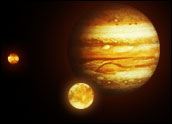
The fireworks may be finished, but some elaborate light shows still await you in the July sky. Jupiter reaches what’s called “opposition” — meaning it and the sun are on opposite sides of the Earth — on Wednesday night. Put simply, it’ll be the biggest and brightest thing in the sky all night long. Then, a day later, Saturn and Mars will put on a spectacle of their own.
Jupiter’s prime position is an annual affair for astronomers. Compared to other sky-gazing events, though, this is one anyone can see — no special expertise or equipment required, outside of eyes.
Jupiter in July
July is a big month for the so-called “king of the planets.” Wednesday marks Jupiter’s closest point ever to Earth, and that means it’ll be at its best visibility — shining eight times as brightly as the next brightest star.
“Just as the full moon … rises every month just at sunset and sets at dawn, so does Jupiter when it is at opposition,” NASA Senior Outreach Specialist Jane Houston Jones told TechNewsWorld. “Jupiter is always brighter than the brightest star whenever it is visible in our sky.”
All month, the giant planet will be particularly noticeable — if you know where to look.
“It is the bright object rising a little after sunset in the southeastern sky. You just can’t miss it! The best time to view it is the hour or so on either side of midnight this month,” Jones said.
Wednesday’s event, though, will be especially hard to miss — whether you’re an amateur astronomer or just an average stargazer.
“Usually something will happen in the sky and I’ll have to say, ‘You’ve got to go to this really dark site, you have to line up these six stars, you have to stand behind a tree and close one eye,'” laughed Astronomy Magazine Senior Editor Michael Bakich. “Not this time.”
While clearly visible, the planet will only be about a third to halfway up in the sky, depending on your location.
“It happens to lie in one of those southern constellations — Sagittarius — so that’s why it’s not climbing really high this year,” Bakich told TechNewsWorld. “The planets follow the path of the sun, only on much slower courses. The sun in our part of the world is highest in the summertime, lowest in the winter. In the winter, the sun is actually in front of the stars of Sagittarius, and that’s where Jupiter is now.”
The atmosphere, Bakich theorized, works like a “murky lens” — meaning the more atmosphere you’re forced to look through, the worse objects in the sky will look.
“If Jupiter were in, say, Taurus or Gemini, it would appear overhead and people looking through telescopes would have a much clearer view,” Bakich said.
A Giant Ball
Murky or not, Jupiter’s apparent size in the sky shouldn’t come as a surprise: It’s the largest of all the planets — so large that you could stuff 1,300 Earths inside of it (though we don’t recommend trying).
“It’s not just a little bigger than Earth — it’s gigantic compared to Earth. It’s bigger and it has more material than all the other planets combined. Because it’s so big, even though it’s roughly half a billion miles from the sun, it still reflects enough light to shine really brightly in the sky,” Bakich noted.
At its 481 million mile distance Wednesday night — yes, that’s considered close — you’ll be able to see some spectacular detail of the hydrogen- and helium-filled ball.
“Through a telescope, you can see dark belts and light zones. They look like stripes. Often you’ll see up to four of Jupiter’s moons lined up on the east and west of the planet,” said NASA’s Jones.
Without a telescope, your best bet for a good glimpse is close to midnight, particularly if it ends up being a clear night.
Astronomer Excitement
Whatever the conditions, you can count on plenty of space enthusiasts turning an eye to the sky. Many cities have astronomy clubs and associations that’ll be watching the opposition.
“We’ll be observing Jupiter,” Los Angeles Astronomical Society President David Sovereign told TechNewsWorld. “With even a small telescope, you can see four main moons and probably pick up some cloud bands.”
The LAAS won’t hold any special event for the occurrence, but members will be looking.
“We see it every year,” Sovereign commented. “We saw Saturn and Mars in opposition a few months ago. When you observe it, it’ll be large.”
Saturn, Mars and Meteors
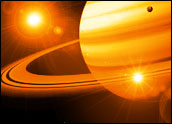
Don’t hang your space cowboy cap once Jupiter’s jaunt is over: Saturn and Mars will be close enough to be seen in the same binocular view that next night, July 10.
“The two planets have been creeping closer to each other for the past couple weeks,” Jones said.
In actuality, Jones said, Saturn is 930 million miles from Earth and Mars is 205 million miles away. To the eye, though, they’ll look very close. You’ll want to look to the west.
Also on the way: the Perseid meteor shower, expected around Aug. 11. The show happens annually as the Earth passes through a comet’s leftover particles.
“Get away from city lights and you’ll see many more of the fainter meteors,” Bakich suggested.
Whatever your fancy, Mother Nature has something in store for you this month. They may not be the pyrotechnics you drooled over this weekend, but hey — these fireworks have a better backstory, and you don’t even have to clean up when they’re done.












 Loading ...