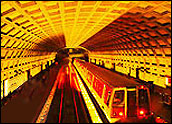
A joint venture called "Transit Wireless" has won a 10-year contract with the New York City Transit to wire its subway stations for cell phone use. The project does not include the actual tunnels in deference to people who do not wish to be exposed to a sea of chatter. The connectivity will reportedly begin in about two years at six stations in downtown Manhattan.
Transit Wireless, a joint venture that includes Nab Construction, Q-Wireless, Dianet Communications and Transit Technologies, won the right to wire for cell phone use New York City Transit's 277 subway stations in a 10-year contract valued at US$46.8 million, according to news accounts of the closely watched bidding.
As part of the project, Transit Wireless will bear the estimated $150 million to $200 million building costs. It will receive fees from cell phone providers to carry their signals on the subway network.
The project -- which does not include the actual tunnels in deference to people who do not wish to be exposed to a sea of chatter -- will reportedly start to go live in about two years at six stations in downtown Manhattan. The joint venture will then have another four years to connect the additional stations.
Join the Crowd
This deal puts New York on a small but growing map of municipalities whose subway systems are wired for cell phone use. The first was, not surprisingly, San Francisco in 2005 when BART (Bay Area Rapid Transit) wired its system. Other major city subway systems, such as Washington, D.C.'s metro, also are wired for cell phone use.
The development is evoking both delight and irritation from subway passengers. New York City has address both camps with its approach. Its intent is to provide travelers with few extra minutes of connectivity as they move from the street to the trains. Once the train pulls out from the station, though, the signal goes dead.
No Stock Tips Please
In that respect, Neil Gussman, communications manager for the Chemical Heritage Foundation, is thankful for small favors.
"I have a 70-mile commute from Lancaster, Pa., to Philadelphia, which includes Amtrak and the Market Street subway line," he told TechNewsWorld, "and ride the New York subway on a regular basis when I am in town as well.
"In my experience, cell phones limit the ridership of Amtrak and regional rail -- I know people who drive to avoid being seated with or near the moronic conversations people have on cell phones in trains."
Adding cell phone conversations to the gestalt that is the New York subway would be, Gussman said, very sad.
"I use the subways to get around town. I don't want to hear about stock deals and someone's problems with his or her mother when I am underground."
What's Eating Citywide WiFi, Part 1 September 20, 2007
"Big-city WiFi is dead at the moment, because the cost and requirements were a big mismatch with where the money can come from for the projects. EarthLink offered too much, realized it and pulled back, but no one is stepping up to take their place because no other firms could build San Francisco, Houston, Chicago or other cities and make money either," said Glenn Fleishman, a journalist and veteran WiFi industry watcher.
Related Stories
Calif. Law Separates Teen Drivers From Cell Phones September 14, 2007
Starting next July, teenage drivers in California will not be allowed to use electronic devices while driving a car. This ban will take effect around the same time as a law requiring adults to use hands-free devices when using a cell phone behind the wheel. Similar legislation has passed or is pending in several other states, and the rise of such laws could be a boon to voice-activated technology.
Microsoft Drops Zune Phone Hint, Trims Music Player Price September 05, 2007
Microsoft may be working on a Zune phone. Mindy Mount, CFO of Microsoft's entertainment and devices division, reportedly told investors at a Citigroup global technology conference that it would not be unreasonable to suggest that the company could be developing a device with music and phone capabilities.
More by Erika Morphy
Windows 7 Flies Off the Shelves November 06, 2009
Early sales figures on Windows 7 boxed software suggest a high level of consumer enthusiasm for the OS. Unit sales were a whopping 234 percent higher than Vista's out of the gate. The revenue haul was not as impressive, as Microsoft offered sharp discounts to spur presales. Also, sales of PCs with Windows 7 preinstalled have been lackluster -- but October is historically a weak month for PC sales.
Southwest Doesn't Fool Around November 06, 2009
Either Southwest Airlines had better deals for my favorite route than its competitors or its superior Web site tools made it easier for me to ferret them out. Either way, kudos to Southwest. In the not-so-hot department were the airline's long list of what passengers weren't allowed to do and its very short list of what Southwest was obliged to do for them. Left me feeling a little chilly.
Commerce Search Puts Google Inside Retailers' Catalogs November 05, 2009
Google has launched a new cloud-based search tool targeting enterprise-level e-commerce operations, just in time for the 2009 holiday selling season. Commerce Search provides a set of features designed to improve the relevance of results for consumers searching a retailer's own product catalog, while boosting cross-selling opportunities.