
- Welcome Guest
- Sign In
- Welcome Guest
- Sign In
Blanket moratoriums and federal mandates aren't the answer to growing concerns about the impact of data center proliferation on local water supplies, according to a report released Monday by a science and technology policy think tank.
"Technology exists, and policy instruments are available, to develop a new, state-led model of water governance for data centers and other large industrial users," noted the report by Robin Gaster, research director of the Information Technology & Innovation Foundation's Center for Clean Energy Innovation.
"What's missing is institutional coordination, regulatory specificity, and a set of standardized mechanisms and metrics," he added.
"You can't fix what you don't measure, and right now nobody measures water consumption the same way on a state or federal level," explained Stuart Lacey, founder and CEO of Labrynth, a global platform for streamlining regulatory, permitting, licensing, and compliance processes for heavily regulated industries.
"State officials, regulators, and communities are all left guessing about storage and consumption," he told TechNewsWorld.
"More than $130 billion in projects got delayed or scrapped in the first quarter of this year, and very little of that was about actual scarcity," he said. "It was about trust, and trust starts with data everyone can see."
The report noted that data centers directly consume only a small fraction of the nation's water supply.
The most widely used estimate of water consumption by data centers is from the Lawrence Berkeley National Laboratory, which concluded that data centers directly consumed 17.4 billion gallons annually in 2023 and indirectly consumed another 211 billion gallons for electricity production, or 12 times the amount of direct consumption.
All told, it continued, that would amount to less than 1% of total U.S. water consumption.
"Data centers in the United States [directly] consume roughly 17 billion gallons of water per year," said Mark Meckler, president of the Convention of States, a group advocating a convention to amend the Constitution to limit federal power and impose fiscal constraints.
"That's not even a third of a percent of all water usage," he told TechNewsWorld. "By comparison, golf courses consume somewhere between 450 and 500 billion gallons of water. Data centers don't even make a mark in that if you double their water usage."
Gaster noted in a statement that communities are not wrong to be concerned about what large data centers mean for local water supplies, but treating the whole country as if it has the same water problem will produce bad policy.
"Arizona, Pennsylvania, Georgia, and Virginia face different water realities," he said. "The answer is not to stop data center development. It is to make water impacts visible, measure them consistently, and regulate them where the local watershed actually needs protection."
Meckler asserted that water consumption should be managed at the local level. "If a data center is looking to be sited somewhere, it should be required by local jurisdictions, from the state all the way down to the municipal level, to demonstrate what [the] water usage will be and how it's accounting for it."
Data centers use so much water for the same reason any heat-intensive industrial operation does: they generate enormous amounts of heat that has to go somewhere, explained Whitaker Irvin Jr., president and CEO of Q Hydrogen, a developer of sustainable hydrogen energy technologies in Park City, Utah.
"The servers and networking equipment inside a modern AI data center run hot, and if you don't pull that heat out, the equipment will fail," he told TechNewsWorld.
"Water has historically been one of the cheapest and most effective ways to do that at scale," he explained, "but with the rapid growth of AI and digital transformation, the scale has grown dramatically."
"They are now essentially small power plants in their own right," he continued, "and the water math that worked before doesn't hold up when you're multiplying it across hundreds of facilities in regions that are already under water stress."
He added that indirect water consumption by data centers is where the staggering numbers come from and is the piece the industry has been slowest to figure out.
"Every megawatt of power a data center draws from the grid has a water footprint attached to it somewhere upstream, whether that's in the gas plants, coal facilities, or nuclear stations generating the electricity to run it," he said.
"The industry has gotten pretty good at telling a story about what happens inside the building, but hasn't been nearly as honest about what's happening in the power generation life cycle that makes the building run the way it does," he added.
The report also noted that the technology to sharply reduce water use already exists. New data center cooling systems can use little or no water directly, and some hyperscalers are already adopting zero-water cooling designs, it explained.
Nvidia has announced liquid-cooling technology for its Rubin generation of AI infrastructure that can reduce water consumption to near zero, it added, while Microsoft has introduced AI-optimized data centers that use closed-loop systems with zero water for cooling operations.
One of the most practical near-term cooling options for high-density AI systems is closed-loop, direct-to-chip liquid cooling, said Lillie Karch, a senior director at EY-Parthenon, the global strategy consulting arm of Ernst & Young.
"Instead of cooling the whole room, the cooling system brings liquid directly to the hottest parts of the server," she told TechNewsWorld.
"In a closed-loop system, the coolant is recirculated rather than continuously evaporated," she explained. "That can significantly reduce the need for fresh water, especially when paired with dry coolers that eject heat to outdoor air instead of using evaporative cooling towers."
However, she acknowledged a tradeoff to the technology: complexity. "Direct-to-chip liquid cooling requires specialized cold plates, piping, pumps, leak detection, and maintenance practices," she said. "But for the very high-density chips now going into production, liquid cooling is increasingly less of a luxury and more of a necessity."
The report also recommends requiring all large industrial users to disclose water-use data. Water use should be tied to performance standards rather than adoption of specific technologies, and water and electricity regulators should develop joint review protocols.
Requiring water data from large users is the right structure, and it mirrors what is already happening on the electricity side, noted Mark McNees, director of social and sustainable enterprises at the Jim Moran College of Entrepreneurship at Florida State University in Tallahassee, Fla.
"The core problem is that there is no accurate national data on how much water data centers consume, because facility-level data is not collected consistently, and indirect consumption through power generation is harder still to capture," he told TechNewsWorld.
"You cannot manage what you cannot measure," he said. "Standardized facility-level disclosure of total withdrawals, total consumption, water source, peak-day demand, and full-build projections is the foundation on which everything else depends."
"Technology-neutral performance standards are smarter than picking winners," he added. "Mandating a specific cooling technology locks in today's engineering and freezes out whatever comes next. A performance standard sets the target for water use and lets operators meet it, however, the economics and the local watershed allow. It also travels better across a diverse industry, since a facility in Arizona and one in Virginia face very different water realities."
He acknowledged that one of the biggest obstacles to data collection will be confidentiality. "Economic development deals routinely include terms that block disclosure of resource use," he explained.
"States have the leverage to fix this because they are the ones offering the incentives," he continued. "The report's point that disclosure rules should override blanket confidentiality claims for core water metrics is the crux."
"Total water use is a public-resource question, not a trade secret," he argued. "States can use the same economic development levers that attract these projects to require disclosure as a condition."
"Reporting also has to be independently audited at the state level to have teeth," he added.
If you judged the AI revolution solely by the stock market, you might conclude that artificial intelligence has already transformed corporate America. A significant portion of this phenomenon can be attributed to financial analysts who prioritize AI infrastructure expansion.
Nvidia has become one of the world’s most valuable companies. Dell Technologies has emerged as one of the biggest winners of the AI infrastructure boom. Hyperscale cloud providers continue to invest hundreds of billions of dollars in AI data centers, while semiconductor companies are enjoying one of the strongest growth cycles in decades.
The investment story is impossible to ignore. What has been less visible is the productivity dividend that those investments are expected to deliver. AI has fueled the largest infrastructure buildout in technology history, yet most companies have not fundamentally changed how work gets done.
Employees are using ChatGPT to summarize meetings, marketing teams are generating first drafts, and developers increasingly rely on coding assistants. Those are meaningful improvements, but they remain incremental rather than transformational. The biggest gains are still ahead.
The next phase of AI adoption will be far more consequential than the infrastructure boom itself, as organizations begin to embed AI directly into business processes rather than simply using it as a conversational assistant. That shift will create new opportunities to reduce costs, improve decision-making, accelerate product development, strengthen customer experiences, and generate incremental revenue.
Ironically, the impact could be even greater for small and medium-sized businesses, which typically have fewer legacy systems, less bureaucracy, and cleaner workflows than their Fortune 500 counterparts.
One of the clearest indicators of where enterprise AI is heading comes from the companies developing the technology themselves.
A recent Wall Street Journal article examined how OpenAI, Google, and Anthropic are deploying AI internally. Beyond summarizing meetings and drafting emails, these companies are using AI agents to execute multistep business workflows, with employees supervising, validating, and refining the output.
AI is evolving from a productivity assistant into a digital coworker capable of taking on substantial portions of knowledge work, leaving employees to apply their experience, judgment, and critical thinking where they add the greatest value.
OpenAI provides one of the clearest examples. The company says nearly every employee — not just software engineers — now uses Codex every week. Originally built to help developers write code, Codex now investigates customer billing issues, builds dashboards, creates product demonstrations, analyzes employee disclosures, and assists legal teams with routine document reviews.
AI eliminates organizational bottlenecks by enabling a single employee to complete work that previously required coordination among multiple departments.
Lawyers still review legal documents, but AI performs much of the initial analysis, allowing legal professionals to focus on higher-value work requiring experience and judgment.
Google’s finance organization tells a similar story. AI agents now compare vendor invoices against contract terms before employees review exceptions.
According to Google, the system allows finance teams to process roughly five times more invoices without increasing staffing. Even more impressive, Google estimates that the initiative could prevent nearly $200 million in invoice overpayments annually.
AI is freeing finance professionals to investigate anomalies, conduct higher-level audits, and improve the models supporting the business.
Anthropic applies the same philosophy across its marketing operations.
Employees use Claude to automate event creation, campaign management, and repetitive data imports that previously consumed hours of manual effort. One AI agent performs the work while another reviews it before a human approves the final result.
The workflow closely mirrors how many organizations already operate: junior employees prepare work, managers review it, and executives give final approval. AI is fitting into that existing structure rather than replacing it altogether.
While software companies demonstrate how AI changes day-to-day operations, Dell highlights another critical part of the AI economy. Dell has experienced a remarkable resurgence by positioning itself at the center of enterprise AI infrastructure. Its AI-optimized servers, storage platforms, networking portfolio, and integration expertise have become foundational components for organizations building private AI environments and large-scale AI factories.
Only a few years ago, many investors viewed Dell primarily as a mature PC company. Today, enterprise AI has created an entirely new growth engine that has fundamentally changed the company’s trajectory.
Dell also illustrates an important lesson: not every AI winner will build foundation models. Many of the biggest beneficiaries will enable AI rather than create it. Every AI deployment requires servers, storage, networking, cybersecurity, cooling, and systems integration. The companies providing that infrastructure are becoming just as strategically important as the companies developing the AI models themselves.
The companies building AI are hardly alone:
Although these companies operate in very different industries, they share the same objective: using AI as a force multiplier that enables employees to accomplish more with the same resources.
Few topics generate more debate than the question of whether AI will replace workers. Some displacement is inevitable, particularly for repetitive and highly structured tasks. History, however, suggests that transformative technologies rarely eliminate entire professions. Instead, they reshape how professionals spend their time.
Spreadsheet software did not eliminate accountants. Computer-aided design did not replace architects. Electronic medical records did not make physicians obsolete. Each technology automated routine work while allowing professionals to focus on higher-value responsibilities.
Lawyers will spend less time reviewing contracts, financial analysts less time building spreadsheets, sales teams less time researching prospects, and software developers less time writing repetitive code. The jobs remain, but the work becomes more strategic.
AI may become the greatest productivity amplifier knowledge workers have ever experienced because employees equipped with intelligent assistants will analyze more information, serve more customers, make faster decisions, and complete substantially more work. Companies that successfully combine human judgment with AI automation will almost certainly outperform those that rely on either alone.
Ironically, the biggest productivity gains may come from outside the Fortune 500, where small and medium-sized businesses often have simpler operations, fewer applications, and less technical debt.
A regional accounting firm, insurance agency, medical practice, or manufacturer can automate scheduling, invoicing, proposal generation, customer communications, and compliance reporting far more quickly than a multinational enterprise burdened by decades of legacy systems.
For these businesses, AI could deliver the equivalent of adding employees without a proportional increase in payroll.
The opportunity comes with challenges. The Wall Street Journal noted that Google actually created downstream bottlenecks after dramatically increasing invoice processing because human teams could not keep pace with the volume of discrepancies AI identified.
Gartner estimates the average Fortune 500 company could deploy more than 150,000 AI agents within the next two years, yet only a small percentage believe they have adequate governance in place.
Capturing AI’s full value will require more than deploying new software. Companies must redesign business processes while strengthening governance, accountability, security, and human oversight, all of which will separate AI leaders from AI followers.
The AI revolution is entering its second chapter. The first was defined by GPUs, hyperscale data centers, foundation models, and unprecedented infrastructure investment, which have already reshaped capital markets and created tremendous shareholder value.
The next chapter will be measured very differently. Success will not be determined by how many GPUs a company owns or how many AI models it deploys. It will be measured by lower operating costs, higher employee productivity, faster innovation, stronger customer relationships, and sustainable revenue growth.
The long-term winners will not necessarily be the companies that spend the most on AI. They will be the companies that deliberately and thoughtfully redesign business processes while preserving the uniquely human capabilities technology cannot replicate.
Despite the fear-mongering from some, AI is unlikely to replace entire workforces anytime soon. Instead, it is more likely to supercharge the people who know how to use it effectively. When that happens at scale, the productivity dividend investors have been waiting for may finally rival the infrastructure boom that started it all.
Qualcomm recently unveiled its Snapdragon Wear Elite platform, a new processor designed to bring more AI processing directly onto wearable devices.
Wearables have long been limited by battery life, heat, and processing power. Built on a 3-nanometer process, the new platform is designed to improve efficiency while providing the performance needed to run more advanced AI workloads directly on the device rather than in the cloud.
One of its most notable features is a dedicated neural processing unit (NPU) that can run large AI models locally, enabling wearables to perform more tasks without relying on cloud processing.
It also supports 5G RedCap, Wi-Fi, Bluetooth 6.0, and satellite messaging. Together, those capabilities help address many of the limitations that have held wearables back. Whether consumers ultimately benefit will depend more on how device makers implement it than on Qualcomm's silicon alone.
Let’s talk wearables this week. Then, we’ll close with my Product of the Week, a wearable device I use regularly that has become more useful than my smart glasses.
Before looking at the potential pitfalls, it's worth considering what this hardware makes possible. By moving more AI processing onto the device, wearables can reduce the latency, connectivity dependence, and battery drain associated with constant cloud communication. That makes a wider range of AI-powered features feasible on smaller devices.
Location awareness could also improve. More precise positioning may help wearables determine a user's location more accurately, even in dense urban environments, improving navigation, health monitoring, and other context-aware applications. Rather than simply recording a high heart rate, on-device AI could combine biometric, environmental, and activity data to determine whether a notification is actually meaningful before alerting the user or contacting emergency services.
Better storage, wireless connectivity, and processing could also make wearables more capable as standalone devices for music, communications, and navigation without requiring a nearby smartphone. Satellite connectivity may also improve emergency communications and location sharing in areas without cellular coverage.
Ultra-wideband (UWB) support could also expand digital key functionality already available in some vehicles, allowing compatible wearables to unlock and start a car without removing a phone or key.

Ultra-wideband technology can allow compatible smartwatches to unlock and start supported vehicles without using a physical key or smartphone. (AI-generated image)
The added processing power could also expand the use of enterprise applications such as body-worn cameras, industrial safety equipment, and other wearable devices that rely on on-device AI.
Despite those advances, I'm cautious. The technology industry is full of impressive engineering that failed because companies focused more on specifications than on the overall user experience. If this new platform is going to succeed, its hardware partners will have to avoid repeating those mistakes.
Consider IBM's early smartphone efforts, most notably the Simon Personal Communicator, as well as its modular PC concepts. IBM excelled at engineering but often designed products that appealed more to engineers than to everyday consumers. The technology was innovative, but the devices were bulky, the interfaces were complicated, and the overall experience failed to attract a broad audience.
Dell repeated many of the same mistakes with products like the Dell Digital Jukebox and later the Dell Streak and Aero smartphones. The company focused on matching competitors' specifications rather than delivering a complete user experience. Strong hardware alone wasn't enough to overcome weaker software and ecosystem support, and Dell abandoned the products rather than continuing to refine them.
Microsoft provides another cautionary example. The company had the resources to compete with Apple's iPod, but early Zune products emphasized features such as restrictive digital rights management and peer-to-peer sharing instead of creating a simpler music experience. By the time Microsoft released the much-improved Zune HD, consumer interest had largely shifted elsewhere, and the company eventually exited the market.
Those same lessons apply to today's wearables. The technology continues to improve, adding better sensors, wireless connectivity, and increasingly capable on-device AI. Yet many wearable products still struggle to gain broader consumer acceptance because manufacturers often prioritize technical capabilities over the overall ownership experience.
First, appearance matters. Unlike a smartphone that spends much of its life in a pocket, a wearable is constantly visible. If a smartwatch looks more like industrial equipment than something people want to wear every day, many consumers won't give its technology a chance.
Second, too many wearables remain unnecessarily complicated. Useful features are often buried behind multiple menus or confusing setup procedures. Most consumers won't spend time learning hidden features if they aren't easy to discover and use from the start.
Third, ecosystem integration still matters. If a wearable requires frequent troubleshooting to stay connected with a phone, vehicle, or cloud service, it quickly becomes more frustrating than useful. The best technology fades into the background instead of demanding constant attention.
If Qualcomm's hardware partners — including Samsung, Motorola, and Google — want to avoid repeating those mistakes, they should pay close attention to the approach Apple took with the iPod and, later, the Apple Watch. Apple didn't succeed simply because its hardware was better. It succeeded because it built products that were easier to understand and more enjoyable to use.
Apple rarely enters a product category first, nor does it always offer the strongest technical specifications. Instead, it has consistently focused on delivering a better user experience. The iPod succeeded not simply because of its hardware, but because Apple paired it with iTunes, simplified navigation through the Click Wheel, and produced a device people enjoyed carrying and using.
Apple also demonstrated something many technology companies struggle with: a willingness to keep improving the product after launch. The first Apple Watch wasn't an immediate success, and Apple adjusted both the product and its marketing over time. By shifting the emphasis toward health, fitness, and everyday convenience, the company steadily improved the experience until the watch became the market leader.
Qualcomm has given manufacturers a stronger technical foundation for the next generation of wearable devices. Whether that translates into better products will depend on how manufacturers use it. More powerful processors won't compensate for awkward software, unattractive designs, or fragmented ecosystems. If wearable makers want broader consumer adoption, they must make the technology disappear behind products that feel simple, reliable, and enjoyable to use.
Qualcomm's latest wearable platform represents a meaningful advance in wearable hardware, giving manufacturers more computing power and connectivity than previous generations. But better chips alone won't expand the wearable market. Companies building on this platform still have to solve the challenges that have limited adoption for years: attractive design, intuitive software, seamless integration, and a commitment to improving products after launch.
If manufacturers can pair this new hardware with products that are attractive, intuitive, and reliable, this generation of wearables could finally reach its potential.

Smartphones have made it easy to document incidents in public, but pulling out a phone during a confrontation can also attract unwanted attention. In some situations, visibly recording an encounter may escalate tensions or put the person recording in an uncomfortable position. That has created interest in less conspicuous ways to capture video when documenting events may be appropriate.
Body-worn cameras have demonstrated the value of firsthand video documentation, particularly in situations where events unfold quickly. While consumers have smartphones that can serve a similar purpose, using one isn't always practical during unexpected or stressful situations. A wearable camera offers a hands-free way to document events without requiring someone to hold a phone throughout an encounter.
This brings us to my Product of the Week: the VibeLens MusicCam camera headset.
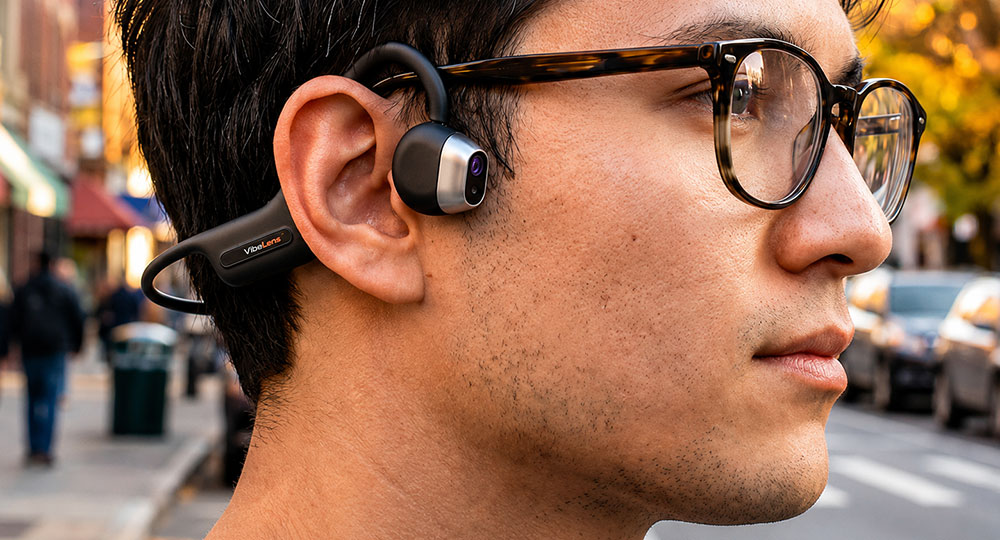
The VibeLens MusicCam combines a wearable camera with an open-ear wireless headset. (AI-generated image)
This device illustrates the kind of real-world wearable technology I discussed above. Rather than trying to replace a smartphone, the VibeLens MusicCam combines a point-of-view camera with an open-ear wireless headset. The result is a wearable that records hands-free video and functions as an everyday headset.
The open-ear design is another advantage. Unlike traditional in-ear earbuds, the headset leaves the ear canal unobstructed, allowing users to remain more aware of surrounding sounds — such as traffic or conversations — while listening to music or taking calls. That makes it well-suited for outdoor activities and other situations where maintaining awareness of one's surroundings is important.
Another advantage is compatibility with prescription glasses or sunglasses. Because the VibeLens isn't built into a pair of smart glasses, users can continue wearing the eyewear they already own rather than investing in a dedicated set of smart frames. It's a practical example of wearable technology adapting to the user instead of requiring the user to adapt to the technology.
By combining hands-free video recording with an open-ear headset in a single device, the VibeLens MusicCam camera headset demonstrates how wearable technology can solve real-world problems without adding unnecessary complexity. That's why it's my Product of the Week.
Not that critics of data center expansion needed another reason to oppose those facilities in their backyards, but they have one: the memory chip shortage.
As fabricators reallocate their resources to meet the demands of the AI industry, the big losers will be consumers, as the prices of the gadgets they love soar.
"AI servers need enormous amounts of memory, and the three makers that supply the world, Samsung, SK Hynix, and Micron, are reallocating wafer capacity to high-bandwidth memory for AI chips because it is far more profitable and effectively sold out," explained Jeff Barrington, managing director of Windsor Drake, an investment banking and M&A advisory firm in Toronto.
"That starves consumer-grade DRAM and NAND, and the prices show it," he told TechNewsWorld. "Contract DRAM jumped about 90% in the first quarter and another 60% in the second, after rising 172% across 2025."
Data centers sit at the center of the shortage because AI servers are memory monsters, explained Francisco Jeronimo, vice president for EMEA and devices at IDC, a market research company in Framingham, Mass.
"A single AI server consumes 10 to 20 times more memory than a conventional workload server, so as the hyperscalers build out, they pull a hugely disproportionate slice of global supply," he told TechNewsWorld.
That scenario is complicated by the same handful of suppliers serving both the data center and the consumer side. "The high-bandwidth memory feeding AI data centers comes off the same DRAM wafers as the RAM in a laptop or phone," Jeronimo said. "Capacity is finite, so a wafer committed to an HBM stack for an AI data center is one that never becomes memory for a mid-range handset."
"It is close to a zero-sum game," he added. "We forecast that data centers will absorb about 70% of all memory produced worldwide in 2026, up from 20% to 30% as recently as 2022."
Sandip Patel, a senior cloud solution architect in Frisco, Texas, noted that it's common to think of memory chips as a commodity that scales with consumer demand. "AI flipped that," he told TechNewsWorld. "Now a handful of cloud providers can outbid the entire consumer electronics industry for the same wafer capacity, and that's exactly what's happening."
"Why chipmakers are chasing that demand instead of sticking with consumer electronics comes down to simple economics," he said. "AI-grade memory sells at a much higher margin than the commodity DRAM that goes into your phone or laptop."
"Fab capacity is finite, so when a manufacturer has to choose, they put their wafers toward the product that makes them more money," he continued. "It's not personal. It's just where the returns are right now, but it leaves less room on the line for consumer chips."
Tzvika Shahaf, senior vice president of product strategy at the Blancco Technology Group, a global company specializing in data erasure and mobile device diagnostics, noted that not only can chip makers get more money for AI chips, but they can also secure longer deals.
"Hyperscalers are driving significant demand with multi-year supply contracts that lock guaranteed capacity at premium prices," he told TechNewsWorld. "The result is that large chip manufacturers have shifted production toward the hyperscalers and slowed down on consumer-grade chips."
The semiconductor industry is highly cyclical because it depends on multibillion-dollar manufacturing facilities, explained Arie Brish, a business professor at St. Edward's University in Austin, Texas.
"The industry is almost either in an over-demand situation or an over-supply situation," he told TechNewsWorld. "The over-demand is usually driven by explosive growth in some segment, such as Covid driving semiconductor demand for videoconferencing, which caused an extreme shortage of semiconductors for other industries. This time the demand is driven by AI."
"During such supply shortages, semiconductor suppliers invest heavily in production capacity to meet the explosive demand," he said. "These capacity expansions take time and money. Once they catch up, we will start to see some relief."
"This relief is expected to emerge gradually in the next few months," he added. "Once the semiconductor suppliers catch up with demand, it is likely to drive a significant drop in semiconductor stock prices."
Jonathan Schaeffer, CEO and founder of Synsira, a Canadian software company that develops AI-powered tools, agreed that relief will be gradual. "Manufacturers are expanding capacity, but semiconductor supply chains do not turn on a dime," he told TechNewsWorld. "High-bandwidth memory is complex to make, and new supply can be absorbed quickly if AI demand keeps rising."
"The better long-term answer is not just more supply," he contended. "It is also better efficiency."
"AI systems need to do more with less through better algorithms, smaller specialized models, data compression, edge computing, and hybrid approaches," he continued. "If the answer to every AI problem is 'build another giant data center,' then we are not being imaginative. We are just being expensive."
"The history of technology shows repeatedly that if demand for a product is large, economies of scale and innovation take over," he said. "With AI, computing infrastructure demand will decrease as the AI algorithms become better, faster, and less resource-intensive."
Blancco's Shahaf pointed to another source of relief for a memory-hungry world. "There is a more immediate lever the industry has largely overlooked — the memory and components already sitting in retired IT assets," he said.
"For years, the default approach to end-of-life IT assets was to destroy-first — erase it, shred it, recycle the raw materials," he explained. "That's effectively throwing working memory away at the same exact time the world can't make enough of it."
"A paradigm shift toward recover-first could put a meaningful amount of much-needed memory, storage, and other components into circulation instead of into a shredder," he predicted.
"With new fab capacity years away, recovering and recirculating what already exists seems to be the most realistic source of relief," he added.
Michelle Lopes Maldonado, associate director of AI policy at the Information Technology & Innovation Foundation, a research and public policy organization in Washington, D.C., predicted that the memory market could take up to two years to recover from the AI-driven surge in demand.
"Since new HBM fabs can take years to reach volume, constraints may not meaningfully ease for consumers for another year or two, particularly if faster fab and grid permitting efforts don't move forward," she told TechNewsWorld.
"Opposition to data center siting over power and water use could have the effect of slowing capacity buildout needed to ease bottlenecks, including new fabs, which is why streamlined permitting and process transparency also play a critical role in addressing this issue," she said.
Resistance to data centers is rising fast at the local level, noted Mark McNees, director of social and sustainable enterprises at the Jim Moran College of Entrepreneurship at Florida State University in Tallahassee, Fla. "In Florida, there are moratoriums in at least 20 counties and communities," he said.
"It is driven mostly by power and water costs, not chip supply," he explained.
"That opposition slows where data centers get built, which over time shapes where demand for chips and everything else lands." However, he added, "It is a siting and cost story before it is a supply story."
Community opposition to data centers will have implications on the expansion rate and the risks associated with how hyperscalers view their scaling possibilities, but in the immediate term, it will not be a relief for the memory shortage, observed Abhijit Sunil, a senior analyst with Forrester Research, a national market research company headquartered in Cambridge, Mass.
"Even if some projects are delayed, cloud providers can redirect investment to more favorable regions since an unprecedented amount of investment has already been committed to AI infrastructure," he told TechNewsWorld.
"One thing enterprise leaders should care about is how AI is resource-intensive and what could be the next bottleneck, both inside and outside the data center," he advised. "Before AI investments stabilize, there could be other bottlenecks and opportunities in the supply chain that are yet to arise."
A multinational aerospace, defense, and security technology company has begun marketing an upgrade to its Automatic License Plate Reader (ALPR) system that records smart device identifiers — like those used by smartphones, earbuds, watches, tire pressure sensors, employee badges and pet microchips.
The upgrade, called SignalTrace, can be installed on the ALPR systems already deployed across the United States by Leonardo, an aerospace, defense, and security technology company headquartered in Rome.
SignalTrace expands traditional ALPR capabilities by detecting and correlating electronic devices near vehicles of interest, the company said in a statement.
By capturing publicly broadcast frequency activity from smartphones, Bluetooth wearables, car infotainment systems, and other devices, it continued, SignalTrace creates a unique "electronic fingerprint" that can be used for investigative purposes.
The system links multiple devices that consistently move with a vehicle, correlating them to the vehicle's license plate and time-stamped location data, it added. Even if a suspect changes or removes a license plate, SignalTrace's algorithms can still provide actionable intelligence by identifying the unique mix of devices they carry or use.
More context is usually better than less, provided it is collected and used appropriately, explained Chris Boehm, chief technology officer at Zero Networks, of Tel Aviv, Israel, a provider of automated microsegmentation, zero trust networking, identity-based access control, and secure remote access services.
"We build security tools that correlate multiple pieces of information because a single indicator rarely tells the whole story," he told TechNewsWorld. "I think the same principle applies here."
"A license plate identifies a vehicle," he continued. "A nearby device identifier can help investigators determine whether the same person or device is consistently associated with that vehicle. That can be incredibly valuable in investigations involving organized crime, human trafficking, serial burglaries, or stolen vehicles where suspects intentionally change cars or swap plates to avoid detection."
However, he cautioned that it is important to remember that this is an investigative lead, not evidence of guilt. "Good investigators should treat it as another data point that helps narrow the search rather than something that automatically identifies a suspect," he said.
SignalTrace is marketed as building a unique "electronic fingerprint" by correlating the Bluetooth, Wi-Fi, and RFID signals that travel with a vehicle, added Tom Bowman, policy counsel for the security and surveillance project at the Center for Democracy & Technology, an online civil liberties and human rights advocacy organization in Washington, D.C.
"For investigators, that means another layer of identification when a plate goes missing and a way to link people, not just vehicles, to a time and place," he told TechNewsWorld.
"But the same feature that makes it useful for tracking a genuine suspect makes it equally capable of tracking everyone else on the road, none of whom consented to having their devices logged," he added.
Bowman noted that collecting device information raises serious privacy concerns. "Your devices are constantly chirping out unique identifiers you can't see and didn't ask to broadcast, and products like SignalTrace are built to scoop them up and tie them to a car and a location," he explained.
"Those identifiers travel with you when you step out of the car, which means the system can begin to map not just where a vehicle went, but where a person then walked," he continued. "Stored in a central repository, it becomes a permanent, searchable history of association and movement."
"Just this week, the Supreme Court ruled that by accessing a user's location history, the police have intruded upon the privacy guarantees of the Fourth Amendment," he said. "SignalTrace reaches for similarly sensitive data through a camera on a pole, but without the constitutional safeguards required by the Fourth Amendment."
Richard Kersey, founder of Chirpper, a decentralized, human-centric, social network based in Liverpool, N.Y., maintained that the core issue is that a MAC address or Bluetooth identifier is a persistent, involuntary handle.
"A license plate is already a registered identifier tied to a vehicle," he told TechNewsWorld. "Pairing it with the wireless identifiers of every phone, earbud, and watch in range means you are no longer logging 'a car passed here'; you are logging 'these specific people, carrying these specific devices, were together at this place and time.' People did not opt into broadcasting that, and most do not know their devices do it."
At its website, Leonardo explained that it does not aggregate, monetize, access, or share LPR data without explicit customer direction. Each agency's data is stored either on-premises or in a dedicated, siloed cloud environment, never pooled into a nationwide database, it noted. Data sharing, when it occurs, is strictly opt-in and fully controlled by the customer agency.
This data sovereignty model ensures that communities, not vendors, decide how LPR data is used, it added.
"The main problem with SignalTrace and other technologies similar to it is that they turn existing ALPR infrastructure into personal device trackers without anything that would require public review," argued Arif Gasilov, a partner with Gasilov Group, a consultancy covering energy, water, and built environment policy, in Tucson, Ariz.
"There is technically no federal law prohibiting law enforcement from collecting Bluetooth identifiers via roadside sensors," he told TechNewsWorld.
"Your phone might be broadcasting a Bluetooth identifier because you're using headphones or a smartwatch, but that does not mean that you're consenting to surveillance while driving to work, so I would say that collecting device information in the way that SignalTrace is doing creates serious questions around individual privacy in this day and age," he said.
Rick Bentley, co-founder of Cloudastructure, a provider of video surveillance and remote guarding services headquartered in Palo Alto, Calif., asserted that collecting device identifier information doesn't benefit legally enforcing traffic laws. "The benefit is only to assist law enforcement in illegally or unconstitutionally spying on citizens," he told TechNewsWorld.
He contended that the business model of ALPR companies is to outsource Fourth Amendment violations from the government to private companies, which sell the information back to the government.
"There is no justifiable reason for a government operating under the Fourth Amendment to record these broadcasts and use that information to do things that would normally require a warrant — like tracking someone's location over time," he said. "The fact that a private company acts as an intermediary does not change the constitutional implications."
"The government cannot circumvent warrant requirements simply by outsourcing the collection to a third party and purchasing the results," he added.
Collecting device identifier data also raises cybersecurity issues. John Gallagher, vice president of Viakoo Labs, an enterprise IoT security company in Mountain View, Calif., explained that SignalTrace can determine which devices an individual is carrying. "If that device is a mobile access control credential, it could be exploited for physical stalking or targeted spearfishing if the threat actor can see where and when it is used," he told TechNewsWorld.
"Of greater impact is if cyber criminals hack the physical security device itself," he said. "Gaining root access could be used to turn the passive monitoring of devices into active injections of malware and exploit kits into the devices."
"This is another example of technology deployment getting ahead of governance," he added. "Many municipalities have policies and open hearings as they deploy LPR systems. This extension of their capabilities to incorporate individually identifiable data should also go through extensive review to determine if it is being secured, governed, and managed in a responsible way."
Malicious actors can also program transmitters to broadcast hardware addresses belonging to others to mask movement or implicate bystanders, added Jason Soroko, a senior fellow at Sectigo, a global digital certificate provider. "Because network identifiers lack authentication protocols, criminals can fabricate evidence," he told TechNewsWorld. "This tactic poisons algorithms and corrupts evidence chains."
In addition, he noted that fusing transit markers with network emissions bypasses randomization safeguards implemented by manufacturers. "Operating systems cycle hardware addresses at intervals to prevent tracking," he explained. "Algorithms correlating identifier clusters with a license plate defeat this mechanism."
"Radio receivers capture signals within a radius, including emissions from pedestrians or traffic," he continued. "This signal bleed guarantees correlation errors, prompting algorithms to assign electronics belonging to bystanders to drivers."
Online safety is no longer just about avoiding bad links and using strong passwords. As generative artificial intelligence (AI) becomes part of everyday life, people must also learn to recognize persuasive AI-generated content, deepfakes, and other increasingly convincing forms of digital deception.
Traditional digital safety focused on multi-factor authentication, lock icons in URLs, and avoiding questionable attachments. Generative AI has expanded those risks by producing persuasive responses, cloned voices, synthetic reviews, and other content designed to appear trustworthy even when it is false. The greatest vulnerability is no longer clicking the wrong link but trusting the wrong answer.
Older adults may be especially vulnerable to those risks. According to Tony Krueck, SVP of Cox Mobile at Cox Communications, company research found that 42% of seniors who use generative AI rely on it primarily as a learning tool. "AI literacy is quickly becoming a core pillar of online safety," he told TechNewsWorld.
AI use beyond the workplace is now commonplace. More than half of seniors (53%) say they use AI, and 42% rely on it to learn new things or solve practical problems.
Exposure to misinformation is a growing threat. Nearly one-third of seniors (32%) and members of the sandwich generation (ages 39–59) report experiencing online misinformation or disinformation over the last 12 months.
The risks extend beyond older adults. The sandwich generation carries much of the responsibility for managing online safety while caring for both teens and aging parents. A significant 86% say managing online safety for both their children and aging parents adds noticeable stress to their lives, and nearly a third find it overwhelming.
The report highlights two primary concerns: online shopping, which 73% of seniors reported as a top concern due to AI-manipulated reviews and fake storefronts, and voice-cloning/deepfake scams that mimic relatives.
Cox Mobile sees the most potential applications in areas where navigating digital tools can be challenging, such as researching health information, understanding financial concepts, or preparing questions before interacting with online services.
Krueck noted that as AI becomes more accessible, older adults embrace it as a resource that helps them navigate an increasingly digital world with greater confidence and independence. It also can make inaccurate information easier to accept as fact.
"The key is balancing AI's convenience with healthy skepticism and verification through trusted sources," he said.
Krueck suggested that AI can help alleviate some of that safety pressure when people use it as a support tool rather than another system to manage. Cox Mobile recently partnered with Sarah Dooley, founder of AI-Empowered Mom, who helps families use AI to reduce their mental load.
"One helpful tip she shares is using AI as a second set of eyes by uploading a screenshot of a suspicious email or text and asking AI to identify potential warning signs before acting," he explained, adding that it can also help answer routine questions and provide guidance for caregivers on everyday technology issues.
"When families use AI thoughtfully and pair it with good verification habits, it has the potential to build confidence across generations," Krueck said.
Traditional search engines provide a list of sources we can vet. Generative AI presents a single, polished answer with complete confidence. That conversational style presents a considerable psychological challenge for older adults. They did not grow up in a world that required constant assessment of whether digital information is real or AI-generated.
"As a result, when an AI tool provides a clear answer in a conversational tone, it can feel less like a search result and more like advice from a knowledgeable person," Krueck noted. "The challenge is that people often equate confidence with credibility."
Generative AI is designed to sound helpful and certain, even when the information delivered may be incomplete or incorrect. Unlike traditional search engines that encourage users to compare sources, generative AI can create the impression of a single right answer.
"That makes it easier to accept information at face value and harder to recognize when verification is needed. The key is remembering that a confident answer isn't always a correct one," he warned.
Nearly three-quarters of seniors (73%) who responded to the Cox Mobile survey identified online shopping as a major security concern. Krueck said generative AI is making scams harder to detect by producing realistic product reviews, convincing storefronts, and responsive customer-service chats that mimic legitimate brands.
"These tactics create a sense of legitimacy that can mislead even experienced online shoppers," he said. "Spotting these risks requires a different mindset."
Instead of relying on surface-level cues like grammar or design, Krueck advised consumers to be cautious when reviews sound overly generic or when sellers pressure them to act quickly or move conversations off-platform.
Deepfakes and voice cloning exploit fear and urgency in ways traditional scams could not. Krueck said telecom providers must strengthen both network protections and consumer education to help families recognize AI-generated voice scams.
"AI-powered voice cloning has introduced a new level of urgency and emotional manipulation into scams, allowing bad actors to impersonate loved ones with striking realism. These attacks succeed because they can panic and pressure people to respond before they have time to verify," he explained.
Technology alone is not enough, he added. Helping customers recognize emerging threats and develop strong verification habits remains essential to protecting them from AI-enabled fraud.
"Understanding when to question what they're hearing, verify through trusted channels, and seek a second opinion is key. This combination of confidence and caution will be critical to staying safe in an AI-driven world," he said.
Krueck said Cox Mobile views digital safety as a responsibility that extends beyond network connectivity. As AI becomes embedded in everyday experiences, helping customers understand how to use these tools and when to question their results has become an important part of delivering a safer digital environment.
To that end, the company introduced a simple framework for users: stop, verify, and ask for help when reviewing a highly specific, confident response from an AI chatbot. He explained that verification starts by stepping outside the original interaction.
"If an AI-generated response includes specific claims about a product, a financial decision, or a health concern, the next step is to confirm it through a trusted, independent source. That could mean checking an official website or contacting a known source directly," he said.
Equally important, he noted, is avoiding reliance on any contact information or links in the original message. The goal is to separate the information from the confirmation process, ensuring that decisions are based on trusted channels rather than potentially manipulated information.
Anyone who follows my work knows I have never been a big fan of Apple. I generally favor open ecosystems, modularity, and raw performance over Apple's closed approach.
As a regular builder of high-performance desktop computers — typically completing two extensive builds per quarter — I strongly favor the AMD Threadripper and Ryzen AI processor lines. For mobile productivity, I prefer 16-inch laptop form factors that offer professional utility, and I actively champion modular PC designs like the Framework Laptop 16.
Apple’s walled-garden approach, characterized by glued-together, non-upgradable components and premium pricing for locked-down hardware, runs fundamentally contrary to how I prefer to interact with technology.
However, credit must be given where it is due. While I might not have adopted its ecosystem, I deeply admired Apple during those golden years when it consistently introduced innovative, distinctive designs that caused genuine disruption and wonder in the market. Back then, Apple did not just launch products; it launched cultural events.
The original iMac G3, the tactile click-wheel iPod, and the first iPhone were not merely functional gadgets — they were visceral, almost emotional experiences. As recent commentary from Gizmodo aptly summarized, electronic devices used to be like collectible toys for adults, objects we fetishized for their visual and tactile aesthetics. They commanded attention and forced every other company in the industry to scramble back to the drawing board.
As we look toward September 2026, when John Ternus is set to step into the role of Apple’s CEO, the drumbeat of change is echoing through Cupertino. Apple's decision to appoint John Ternus as its next CEO could signal a major shake-up and a renewed focus on the bold product design that once defined the company. This marks a pivotal juncture for the company, and honestly, an important one.
The slow decline of Apple’s design dominance did not happen overnight; it was a gradual bleeding of talent and influence that started shortly after Steve Jobs passed away. Jobs and Jony Ive operated in a symbiotic relationship, with design as the undisputed king of the boardroom. Engineering and operations had to figure out how to make Ive’s visions a reality, not the other way around.
When Ive departed Apple in 2019 to form his independent firm, LoveFrom, it left a vacuum. But the bigger problem was how Apple managed that transition.
The company effectively replaced one of the most influential industrial designers in history with its top supply chain executive, Jeff Williams. The studio that birthed the iPhone lost its seat at the executive table, eventually devolving into a service bureau where other teams put in requests for color palettes and minor tweaks.
Evans Hankey, who briefly led the team post-Ive, also left in 2022, triggering an exodus of veteran designers who had defined the Ive era.
I have seen this corporate lifecycle play out firsthand. Having started my career as a financial analyst, audit manager, and project manager at Rolm Systems and IBM, I witnessed what happens when a large entity shifts from being product-led to operations-led.
During my time closely observing IBM before and during the Lou Gerstner era, it became clear that in an operations-centric culture, the spreadsheets dictate the product. Tim Cook is a logistics genius, and he masterfully turned Apple into a supply-chain juggernaut that printed money. But operations executives prioritize efficiency, yield, and risk mitigation. They do not prioritize taking big, expensive leaps of faith on unproven aesthetics.
The result has been a decade of iteration. Today’s iPhones and MacBooks are undeniably competent, but they are also, in my view, profoundly boring. They no longer spark that visceral wonder. They are safe and plain, relying more on consumer inertia and ecosystem lock-in than on raw, eye-popping design appeal.
One might ask why a company generating billions in profit needs to worry about being cool again. The answer lies in Apple's fundamental business model. Apple is a large but relatively slow-moving company that releases flagship products on a rigid annual cadence. It is not a "fast follower."
A fast follower — think of overseas conglomerates that pump out dozens of handset models a year — can afford to wait and see what the market likes, then quickly iterate and release a cheaper version. Apple cannot do that.
Apple commands a premium for its products, the infamous "Apple Tax." You cannot charge a premium price for a commodity experience. To justify the cost, Apple must offer something that feels distinctly superior, and historically, that superiority was communicated first and foremost through design.
I see a direct parallel with the automotive industry. As someone who closely follows the transition to electric vehicles, I see many of the same forces at work there.
The EV market is currently wrestling with how to stand out. When I look at a classic Jaguar E-Type — a car I have a deep interest in converting to an electric powertrain (mine currently has a 569 HP LS3) — it evokes pure, visceral emotion. Its design is timeless and bold. In contrast, many modern EVs look like aerodynamic jellybeans designed by a wind tunnel. They are efficient, but they lack soul. Apple’s recent products have become the jellybeans of the tech world.
When a slow-moving giant fails to innovate, it becomes vulnerable to agile competitors willing to take risks. If Apple’s hardware remains stagnant, competitors who leverage bold new form factors will eventually erode Apple’s market share. To maintain its apex predator status, Apple must be the one setting the pace. It needs to create the trends that others scramble to copy, rather than polishing the same aluminum chassis for a decade.
This brings us to John Ternus and what appears to be his mandate to elevate the industrial design group back to its former glory.
Ternus is an interesting choice to lead this charge. His background is deeply rooted in hardware engineering rather than pure industrial design, having overseen the transition to Apple Silicon and the development of the iPad Pro. However, this engineering pedigree might be exactly what the design team needs to bridge the gap between radical aesthetics and functional reality.
Over the next decade, under Ternus’s leadership, I expect a significant pivot in Apple’s hardware strategy. The era of plain competence will likely give way to bolder experiments. We are already hearing rumors of a jammed 2027 roadmap, featuring a foldable iPhone, a dramatically redesigned MacBook Neo, and camera-equipped AirPods. These are form factors that require a masterclass in design to execute properly without compromising durability or user experience.
I also maintain a strong professional focus on the development of agentic artificial intelligence and the ethics of digital twins. As agentic AI begins to permeate our devices — moving beyond simple digital assistants to systems that proactively manage tasks — the hardware itself will need to evolve.
Future devices may serve as the physical anchors for our digital proxies. I expect Ternus to push Apple toward devices that are more contextually aware, perhaps integrating personal safety technology and satellite-connected hardware seamlessly into the design.
We might see a return to more organic, "huggable" materials that soften the interface between human and machine, moving away from cold metal slabs. Apple’s future designs will likely focus on the seamless physical integration of these AI capabilities, requiring hardware that looks less like a utilitarian tool and more like an intuitive, highly personalized companion.
Ternus has the resources to recruit the best design talent globally. The real test will be whether he has the corporate courage to let that talent take risks that might occasionally fail, because you cannot achieve bold innovation without a tolerance for disruption.
It is easy for a new CEO to claim they will revitalize a company's design culture; executing on that promise is entirely another matter. John Ternus is inheriting a company that has optimized itself for supply chain efficiency at the expense of its creative soul. Shifting that corporate momentum will be akin to turning a supertanker.
However, recognizing the problem is the mandatory first step. By acknowledging that Apple’s design has stagnated and moving to restore the design team's authority, Ternus is showing a level of product-centric leadership that has been largely absent since the Jobs era.
While I remain a die-hard PC builder who prefers the open ecosystem of my custom AMD rigs, I am genuinely rooting for Apple to succeed here. The technology industry thrives on competition, and when Apple takes bold, disruptive swings, it forces everyone else to elevate their game. Let us hope Ternus can bring the wonder back to Cupertino.
If my argument that Apple needs to revive its design language struck a chord, this week's product offers a compelling alternative. While Tim Cook's supply chain churns out another iteration of the safe, predictable iPhone, Carl Pei's company Nothing has been busy building the exact opposite. The Nothing Phone (3) is the antithesis of modern smartphone stagnation and is easily one of the most polarizing, unapologetically bold devices on the market.

The Nothing Phone (3) features the company's signature transparent rear design and customizable Glyph Matrix interface.
What immediately sets the Nothing Phone (3) apart is its refusal to blend in. The industrial design continues Nothing's signature transparent aesthetic, exposing the meticulously arranged internal architecture beneath Gorilla Glass Victus. However, the real showstopper is the newly evolved Glyph Matrix on the rear. Moving beyond the simple light strips of the Nothing Phone (2), this new dot-matrix LED array provides dynamic, deeply customizable visual notifications.
In a world where every other handset is a featureless slab of frosted glass, the Nothing Phone (3) looks like a piece of high-end, retro-futuristic sci-fi hardware. Taking it out for photography tests immediately drew questions from onlookers — a reaction an iPhone has not elicited in a decade.
Beyond aesthetics, the device leans heavily into the era of agentic AI with its new Essential Space software and dedicated hardware button. I already rely on specialized digital productivity tools like the Plaud NotePin for meeting transcription and automated notetaking, so seeing a smartphone successfully integrate a dedicated, hardware-level AI capture key feels like a necessary evolution.
Pressing the Essential key instantly logs voice reminders or screenshots into an isolated on-device AI bucket that contextualizes the data and prompts actionable calendar events. It utilizes localized processing to manage these tasks, keeping the workflow clean and immediate.
Under the hood, Nothing made the pragmatic choice to utilize the Snapdragon 8s Gen 4 chipset. While benchmark purists might lament the lack of the absolute highest-tier Qualcomm variant, the silicon is perfectly paired with the hyper-minimalist, black-and-white Nothing OS 4. The UI flies, completely free of the bloated skins you find on competing Android devices.
Nothing clearly outpaces Apple in battery capacity and charging performance. The 5,150 mAh silicon-carbon battery easily powers through a full day of heavy use, and the 65W wired charging capabilities ensure that when you do need a top-up, you are not tethered to a wall for hours.
This smartphone is not flawless — the AI Super Zoom on the new 50MP periscope lens falls apart rapidly past its native optical limits, and the chassis is undeniably chunky. But perfection is often the enemy of innovation. Nothing is taking massive, disruptive swings at a stagnant market, delivering a device that actually makes using a smartphone fun again.
The Nothing Phone (3) is a reminder that consumer technology should still inspire a sense of wonder, making it my Product of the Week.
Roughly 20 years into the reign of mobile computing devices, those of us who keep apace of such things are probably used to the pageantry of product announcements. The grandiloquence of the painstaking choreography makes an incredulous observer roll their eyes.
But Flipper is one of those rare tech companies that can make announcements that instantly generate unalloyed excitement. The kind that blew right past "oh, huh, that could be useful on my work phone" and into "I can't wait to block out an entire weekend with this thing" territory.
Granted, last month's post on Flipper's official blog wasn't quite that, but it was far from a disappointment. It just wasn't what you might expect. Instead of dangling scant, tantalizing details over fans, Flipper opened its doors to let the community dive right in. Flipper CEO Pavel Zhovner declared as much in no uncertain terms.
"The main reason we opened up all parts of Flipper One before release is that we want to invite the community into the development process, so everyone can contribute and get involved without waiting for the final product," Zhovner said.
Flipper's first foray into hardware, the Flipper Zero, is beloved in the hacker/pentester community (choose your preferred nomenclature). Its cheeky, cyberpunk-inflected pwnagotchi interface endeared itself to users, who found excuses to whip it out. But its arsenal of radio-protocol tools, packed into a palm-sized gadget, can do serious work, as evidenced by its presence in the toolbelt of information-security heavy-hitters.
"The Flipper Zero is one of my favorite devices of all time," said Josh Bressers, VP of security at Anchore and host of "Open Source Security" podcast.
While the community is still fond of the Flipper Zero, they're also ready for Flipper's next chapter and its attendant new capabilities. "I think it's a continuation of what Flipper Zero started," Bressers said. "The features of the Flipper Zero are certainly a bit stale these days."
If anything is true about technology, it's that more of the same just doesn't cut it. Flipper wants to swim at the front of the school, and the forward-thinking woven into the Flipper One planning is proof. Truly, the product was dreamt up before the hardware to support it existed.
"Since 2020, I've been talking about the separation of Flipper Zero and Flipper One," Zhovner said. "One of the reasons we didn't do this sooner was the lack of a suitable SoC [system on a chip] that was simultaneously fast, energy-efficient, and sufficiently open. In 2024, the RK3576 came out, and once we realized it was open enough, we decided the time was right."
In refusing to settle, Flipper ended up preparing for tomorrow — in their assessment, tomorrow has arrived.
The blueprints are ambitious. Flipper One takes the radio-Swiss-Army-knife concept that made Flipper a hackerspace name and sticks a fully customizable Linux OS at its heart.
Serving up the redoubtable Linux userland is FlipCTL, which wraps CLI tools for easy manipulation in the cyberdeck form factor (you have no idea how long I've wanted to write "cyberdeck" in a serious article). Not to be outdone by the likes of the Steam Deck, Flipper One will be just a keyboard and monitor away from acting as a desktop, a capability mainstream consumer tech passed up, but the Linux hardware community keeps alive.
The networking hardware is where hacker types will really get amped up, though. For starters, it boasts a full software-defined radio (SDR), a capability likely to appeal to amateur radio enthusiasts and the growing ecosystem around projects like Meshtastic. On top of that, it adds a satellite modem just in time for satellite communication security to ramp up and companies to explore orbital data centers.
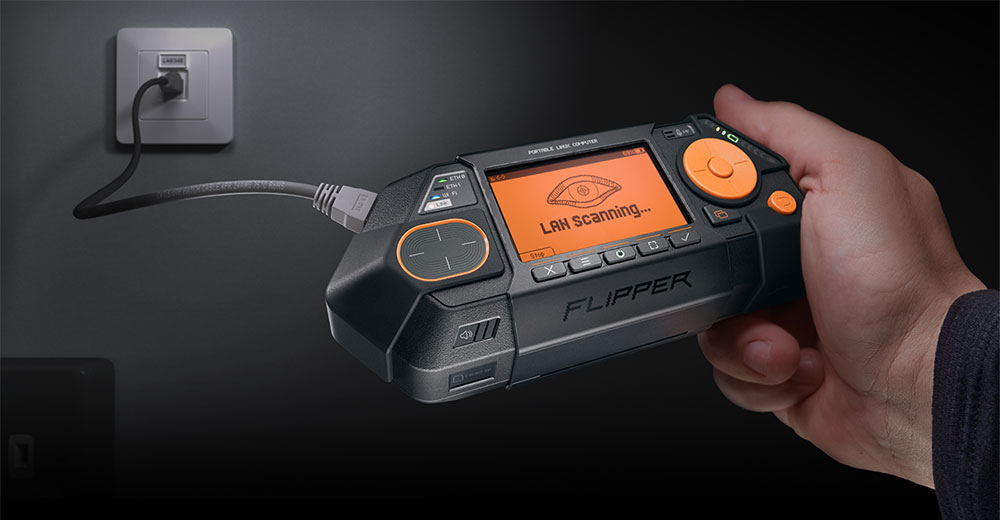
Flipper One is designed to combine Linux, software-defined radio, and networking tools in a portable handheld platform for hardware hackers.
It's also notable that, building around a single-board computer (SBC) with a neural processing unit (NPU), Flipper One could very well be the first end-user Linux device to ship with an LLM preinstalled. Microsoft has the distinction of bringing the first LLM-equipped PCs to market, but let's just say not everyone interested in that likes Microsoft's particular spin.
There are technical hurdles to clear, but they are surmountable. In committing to true "open hardware" (the hardware analog to open-source), Flipper aims for a device that doesn't need to resort to tricks to run stock Linux kernels. Achieving this involves adding the modules that drive Flipper One's hardware to the Linux kernel source code.
"Almost everything Flipper One needs is already in the mainline kernel ... So we're not worried about this at all," Zhovner said. "And fortunately, we're not the only ones interested in mainlining RK3576 — other companies are working on it too."
Bressers also did not view the prospect of mainlining the required kernel modules as especially difficult. "I have no doubt the Linux kernel will take any contributions that follow their rules," he said.
The RK3576 system-on-chip from Rockchip has been out since late 2023. Since then, multiple projects have driven additions to the Linux kernel to support the board. It was designed to suit the burgeoning AIoT class of devices, blending artificial intelligence (AI) with internet of things (IoT) to facilitate applications that perform sophisticated edge compute data processing. Using it to power an SBC for end-users is yet another way Flipper is reimagining the future from bits of the present.
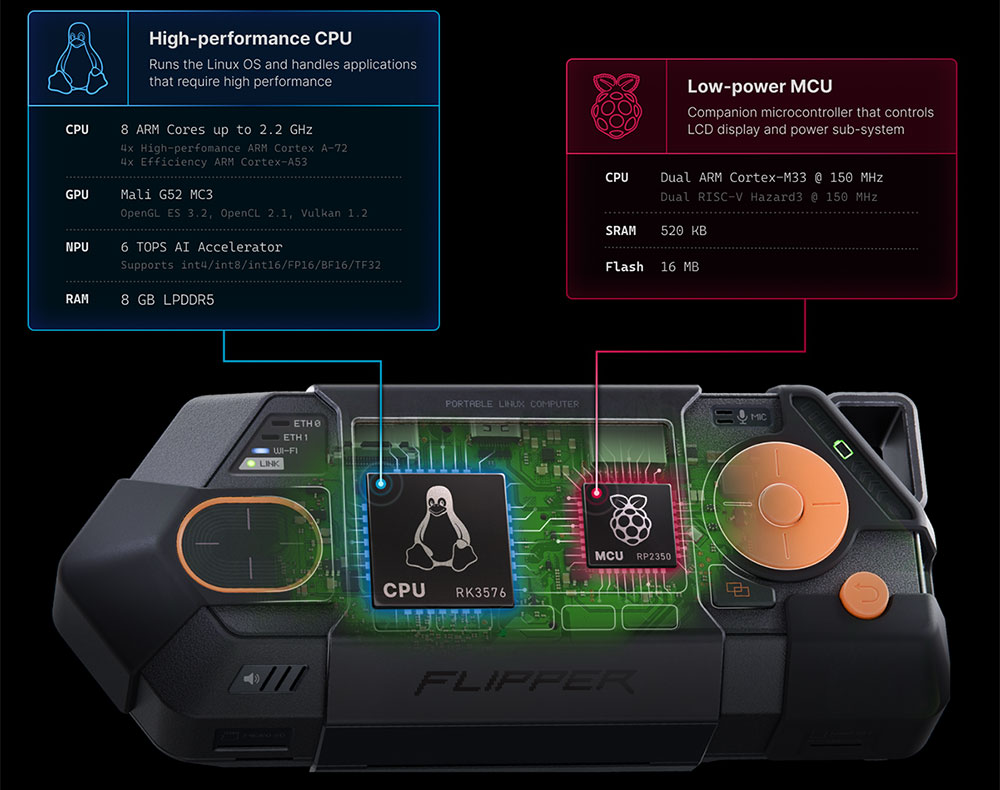
Flipper One pairs a high-performance RK3576 processor that runs Linux with a companion microcontroller that manages the display and power subsystem.
As many components as are packed into the handheld, Flipper maintains that all of them pass their unit tests. The trick is getting them all to play nice. Every additional component exponentially increases the testing workload to ensure everything interoperates harmoniously.
"The current work is systematically identifying all potential side effects across hardware combinations, which requires the firmware to be mature enough to run multiple features concurrently," Zhovner said. "So in a sense, the testing and the development have to advance together."
This is where Flipper is plunging the deepest into uncharted territory: leaning on community contributions before launch. Good open-source citizens that they are, Flipper posted the Flipper Zero's firmware after it shipped. But the point of the May announcement was less to show off previous work, and more to get help on the work that remains. To that end, the company is not shrinking from opening itself up to the level of coordination necessary to pull this off.
"With Flipper One, we decided to go even further and open up the task tracker as well, so anyone can see how the team communicates internally and how we make decisions," Zhovner said.
More than merely extending an invitation, Flipper put out a welcome mat. For prospective contributors wondering how they develop for hardware they don't have, the team published documentation on compatible boards that are already available.
The very innovation that helped make the RK3576 appealing as the basis of the Flipper One — AI — poses the most serious challenge to the quest for the ultimate open project. AI coding assistants have been in the hands of plebeian developers for only a few years, but open-source veterans already consider AI policies indispensable to ensure high-quality contributions.
"For the community contributions that [Flipper is] looking for, which will affect the base operating system, those will probably need a policy that evolves with the contributions proposed," Bressers said.
Flipper is well aware of this. In fact, they know firsthand what the absence of an AI policy invites. Although the exact stipulations are still in flux, an AI policy is taking shape.
"Yes, the AI slop problem has hit us, too," Zhovner said. "So yeah, it's a challenge, we're figuring out how to guard against it and working on establishing some ground rules."
One question sure to be on any backer's mind is, will the device clock in at its price target? Given the component market crunch precipitated by AI hyperscaler buying sprees, this is a trickier needle to thread than the last time around. The $350 figure is where the team is hoping to land the Flipper One base configuration, which won't include the cellular modem.
That's where faith from fans makes or breaks the endeavor. In view of market conditions beyond a manufacturer's control, the way to secure the best offers is to front-load customer commitment.
"That's why hitting a significant Kickstarter funding goal is critical — it directly affects the terms our suppliers offer us," Zhovner said. "Given the ongoing component and RAM shortage, this is no easy feat right now."
Bressers, for one, estimates that a price point in this ballpark is realistic.
"I think it's plausible. A Raspberry Pi 5 with 16GB of RAM is about $300," Bressers noted. "The Flipper One is supposed to have 8GB, so less RAM, but there are other added costs like the screen and radios."
With a Discord of over 116,000 members, there are likely enough die-hard fans to fund the device's first production run far enough out to give the company purchasing leverage with suppliers.
So, what kind of consumer tech landscape will receive the Flipper One when it lands? As a self-proclaimed Flipper Zero fan and someone squarely in Flipper's target audience, Bressers regards the effort as perhaps not groundbreaking but as continuing to serve the niche of aspiring hackers in need of an eminently capable starter pack.
"It won't change the industry, but it sounds like it will continue to be an easy way to start a hardware hacking journey," Bressers said.
Images courtesy of Flipper Devices
Enterprise readiness for AI remains a growing concern, with CTO confidence in scaling the technology falling for the third year in a row, according to a report by a global digital engineering and consulting company.
In its latest "What CTOs Think" report, which is based on insights from 500 CTOs, Akkodis found that CTO confidence in their organizations' ability to implement and scale AI has slipped to 48% in 2026, down from 62% in 2025 and 82% in 2024.
"Many organizations have moved past the question of whether they can access AI," said Akkodis CEO Jo Debecker. "The biggest challenge they now face is whether they can make AI work inside the complexity of the enterprise — across legacy systems, fragmented data, risk controls, governance processes, and human workflows."
"The ability to scale AI in a meaningful way matters because that's how enterprises can see the technology's value," he told TechNewsWorld.
"Pilots can prove what is possible, but scalability is what turns AI into better decisions, faster innovation, and measurable business impact," he continued. "To get there, organizations need more than technology. They need workforce transformation, clear governance, and trust from the people expected to use AI every day."
"Organizations have spent two years running proofs of concept," added Eric Hulse, director of research at Command Zero, a cyber investigation automation company in Austin, Texas.
"The ones stuck in pilot mode are stacking up costs without capturing value," he told TechNewsWorld. "The pressure to scale is real. But the Akkodis data shows confidence in the ability to scale fell from 82% to 48% in three years. That makes sense. The more CTOs grapple with what scaling actually takes, the clearer it gets that most organizations aren't built for it."
Scaling is where many AI programs are getting stuck, observed Ryan McCurdy, vice president of marketing at Liquibase, a database-change automation company in Austin, Texas.
"Companies can get access to capable models, run demos, and show productivity gains. The harder part is turning that into work the enterprise can trust every day," he told TechNewsWorld.
When agentic AI is added to the mix, it raises the stakes, he continued. "It is not just answering questions. It can write code, generate schema changes, update pipelines, and trigger work across the business," he explained. "That requires a different operating model. Teams need to know what agents can do, where humans stay involved, and how AI-driven changes are reviewed, traced, and controlled."
"A lot of organizations have not figured that out yet," he said. "So they either keep AI boxed into experiments, or they move too fast and create risk in production. Neither path scales."
"The companies that get this right will not just buy more AI tools," he added. "They will build the structure around them, such as trusted data, governed workflows, and proof of control. That is how AI moves from interesting experiments to something the enterprise can actually run."
The report explained that as organizations move beyond pilot programs, execution complexity increases across leadership alignment, governance, and workforce trust. It found that fewer than half the CTOs (44%) believe leadership teams have sufficient AI understanding, and only 36% express satisfaction with workforce trust levels.
In addition, the CTOs said that AI progress was being limited by barriers, such as a lack of in-house technology skills (32%), uncertainty around return on investment (31%), and a lack of urgency at the business level (27%).
"Many organizations are adopting AI because they feel pressure to do so," noted John Strand, owner of Black Hills Information Security, a penetration testing company in Sturgis, S.D.
"They're constantly seeing headlines, LinkedIn posts and social media content claiming AI is changing everything, and they don't want to be left behind," he told TechNewsWorld. "The danger is that AI can become a solution looking for a problem."
"AI absolutely has the potential to create value, but organizations need to be strategic about identifying specific pain points and business challenges it can solve instead of spreading it across the enterprise without a clear purpose," he said.
Steven Swift, managing director of Suzu Testing, a provider of AI-powered cybersecurity services in Las Vegas, asserted that the technologies used to accomplish business goals don't matter that much. "What matters is that the business is achieving its objectives," he told TechNewsWorld. "If a business can shift a bunch of legacy costs to a bunch of AI models, it rarely meaningfully changes business capabilities."
"AI labs are selling shovels and shouting to everyone who will listen that there's a gold rush," he added. "Technically, it doesn't mean your organization won't find gold. But most of the money to be made in a gold rush is in selling shovels, not gold."
The plethora of AI tools available to companies is problematic, acknowledged Bob Brauer, founder and CEO of Interzoid, a San Francisco consultancy and provider of enrichment solutions for enterprise data systems.
"Teams are faced with figuring out how to connect those AI tools to real and correct systems," he told TechNewsWorld. "The reason this is a pretty big deal is that enterprises typically have data spread across various systems, and different systems maintain different 'versions of the truth.'"
"Effective AI depends on the quality of the data it is working from, so when teams are faced with messy systems, with issues like old records, duplicate records, or missing fields, the AI then makes bad decisions," he explained. "Because AI is always fast-moving, those bad decisions scale incredibly fast, and companies don't typically find data issues until after they've scaled enough to have negative impacts."
"Ultimately, before an AI integration can connect and scale, companies need cleaner, more consistent data so that the AI is working from information the business can trust," he added.
The Akkodis report also revealed a fundamental shift in how organizations define the value of digital transformation. For the first time, it noted, CTOs cite innovation, not efficiency, as the primary driver of digital investment, signaling a move from cost-focused optimization toward growth, differentiation, and new business models.
As AI capabilities mature, the marginal gains from efficiency are diminishing, increasing the importance of innovation as a source of competitive advantage, it explained. While the shift is global, it continued, priorities vary by industry — from workforce development in aerospace to innovation acceleration in life sciences to resilience in energy — underscoring the need for sector-specific approaches to scaling AI.
"This shift shows that digital transformation is becoming a growth agenda, not just a cost agenda," Debecker said.
"Enterprises are moving beyond using technology to optimize existing processes and are beginning to use it to create new products, services, workflows, and business models," he added. "This change is significant because it changes how leaders measure success, not only by how much cost they remove, but by how quickly they can turn technology into new value for customers, employees, and the business."
"In practice, trust is built through transparency, clear governance, and defined decision rights — ensuring employees understand how AI is used, where accountability sits, and how outcomes are validated."
This shift is a fundamental evolution, declared Josh Stanaland, a partner and CTO of Shark AI Solutions, a product development, AI, and client account management company in St. Petersburg, Fla.
"Previously, digital transformation focused on cost-cutting and doing the same work faster or cheaper," he told TechNewsWorld. "Now, with AI maturing, the top driver is innovation — creating new value, products, business models, and growth opportunities."
"It is significant because it signals a move from defensive optimization to offensive differentiation," he said. "Companies that treat AI as an innovation engine will pull ahead, while those focused only on efficiency risk falling behind."
The U.S. government imposed export controls on Anthropic's Fable 5 and Mythos 5 models on June 12, forcing the company to restrict access to foreign nationals.
Anthropic responded by broadly disabling access to the models after determining it could not readily restrict usage based on nationality alone. Public reports indicate the move was driven by concerns that users could bypass safeguards in Fable 5 through prompts as simple as asking the model to "fix this code."
While Anthropic characterized the issue as a limited vulnerability that was not unique to its models, administration officials viewed the capability as a national security concern, arguing that it could be used to identify software vulnerabilities at scale.
Let’s talk about the Anthropic ban. Then, we’ll close with my Product of the Week: the Motorola Razr Fold.
Anthropic's public reaction was one of forced compliance but vocal disagreement. The company issued a statement asserting that the jailbreak was narrow and non-universal, arguing that forcing a widespread recall over it was an overreach.
However, reports indicate that the government warned Anthropic about the jailbreak beforehand, but leadership allegedly refused to pull the model or patch it immediately. In my view, that likely contributed to the administration's decision to intervene.
If the reporting surrounding the dispute is accurate, Anthropic may have placed too much emphasis on protecting its launch plans and not enough on quickly addressing government concerns. For a company operating at the frontier of AI development, maintaining trust with regulators is becoming a strategic necessity.
To recover from this setback, especially ahead of any anticipated IPO, Anthropic must rapidly pivot.
First, it needs to address the vulnerability that appears to be at the center of the government's concerns and demonstrate that the issue has been effectively mitigated.
Next, the company must develop robust, verifiable geolocation and identity-filtering tools to comply with export controls without resorting to blanket global shutdowns.
Finally, Anthropic must rebuild its relationship with Washington by demonstrating a willingness to work collaboratively with regulators when national security concerns are raised.
This shutdown could provide a significant opportunity for rival AI model suppliers. With Fable 5 and Mythos 5 unavailable, many enterprise users and security researchers will likely evaluate alternative platforms.
OpenAI stands to benefit the most, as its GPT-5.5 model is widely cited as having comparable capabilities and is not currently subject to the same regulatory ban. Other models, such as Google's advanced offerings and Moonshot AI's Kimi 2.7, may also benefit from the disruption. Since these competitors have avoided the regulatory crosshairs, they can market their platforms as stable and fully accessible to enterprise clients who were burned by the Anthropic outage.
The Fable fiasco serves as a stark warning to the broader AI industry: do not play chicken with the U.S. Commerce Department. The export-control action demonstrates that the government is willing to intervene aggressively when it believes national security is at risk.
AI firms are advised to adopt a policy of rapid, good-faith remediation when federal agencies flag vulnerabilities. Engaging in public disputes or refusing backend fixes will inevitably invite the heavy hand of federal regulation.
By using export controls on a commercial software model, the U.S. has signaled that dependence on American artificial intelligence is a strategic liability. That perception is likely to accelerate foreign investment in competing sovereign AI initiatives.
Nations that fear suddenly losing access to state-of-the-art AI tools may increase investment in sovereign AI alternatives.
China and other competitors will heavily subsidize their own foundation models, ensuring they do not have to rely on U.S.-controlled infrastructure that can be abruptly switched off.
Paradoxically, the ban likely makes the digital ecosystem far less safe.
As security pioneer Katie Moussouris highlighted in her analysis, defensive requests like "fix this code" are vital for cybersecurity professionals working to patch legacy systems.
By removing access to Fable 5, the government has essentially kneecapped the defenders who rely on the model for security hardening. Meanwhile, bad actors can simply shift to open-source models or alternative tools.
Denying top-tier vulnerability discovery to the defense side while adversaries continue adapting ultimately degrades overall systemic safety.
The government's decision to restrict Anthropic's Fable 5 and Mythos 5 models could prove to be a watershed moment in the governance of artificial intelligence. Driven by concerns over a cyber-vulnerability jailbreak, the government's export controls have already disrupted the market and may further accelerate interest in sovereign AI initiatives while benefiting Anthropic's competitors.
While Anthropic must now navigate the technical and diplomatic hurdles to restore its flagship products, the broader industry faces a new reality. The delicate balance between national security and technological advancement has shifted, leaving critical questions about whether these restrictions truly protect infrastructure or merely disarm the cybersecurity defenders who need these tools the most.

Image Credit: Motorola Mobility
When Lenovo bought Motorola as a distressed asset from Google, many analysts doubted the brand's long-term viability. However, Lenovo has successfully revitalized the company, transforming it into a powerhouse of mobile innovation. That unwavering commitment to cutting-edge hardware was on full display at Lenovo's Tech World event earlier this year.
The Motorola Razr Fold - 2026 reflects that evolution, showing how Motorola has moved beyond nostalgia and become a serious contender in the premium smartphone market.

Rob Enderle tests the Motorola Razr Fold - 2026.
I currently carry a Google Pixel 10 Pro Fold and have been hooked on foldable phones ever since I carried the now-defunct Microsoft Duo. While the Google phone has been great, it lacks some features and performance of the recently released Motorola Razr Fold, which is why I find myself wanting to trade the Pixel in for the Motorola.
Having consistently evaluated the latest generations of Google's folding devices, I've found the Motorola Razr Fold significantly outperforms the Google Pixel 10 Pro Fold in several key hardware categories.
The Razr Fold features a 6,000mAh battery supported by 80W fast charging, which easily overshadows the Pixel's 5,015mAh capacity and slower 30W charging speeds.
Motorola has equipped its device with a Snapdragon 8 Gen 5 processor and a triple 50MP camera system, leaving the Pixel's Tensor G5 and lower-resolution camera array trailing behind.
When matched up against similar foldable smartphones on the market, the Razr Fold stands out for its ultra-thin 4.7mm unfolded profile and brilliant 165Hz cover screen. While competitors often force buyers to compromise between a slim form factor and adequate battery capacity, Motorola manages to deliver both without sacrificing durability.
Its Pantone-validated aesthetic and Corning Gorilla Glass Ceramic 3 protection make it a premium challenger to the top-tier offerings from Samsung and OnePlus.
The Anthropic controversy also highlights the risks of relying exclusively on cloud-based AI services for mission-critical workloads. The Razr Fold's advanced neural processing unit enables more AI tasks to run locally on the device rather than relying entirely on cloud-based services.
The Motorola Razr Fold - 2026 raises the bar for premium foldables by combining uncompromising battery life, elite processing power, and a superior camera system into a highly refined chassis. It delivers the self-reliant, high-performance experience that modern tech users require. Given its longer battery life and better screen, it is ideal for people like me who often use their phones for reading or watching videos — and it is my Product of the Week.
Fox’s plan to acquire Roku is one of those deals that looks obvious only after someone finally has the nerve to do it.
On paper, it is a $22 billion cash-and-stock transaction. In reality, it is Fox admitting something the entire media industry already knows but still hates saying out loud: the future of television is not just about owning shows, games, or news. It is about owning the interface where people decide what to watch — and the ad paths that follow that choice.
That is why Roku matters.
Roku is not simply a cheap streaming stick company. That description is badly outdated and misleading. Roku is a living room operating system, an ad platform, a discovery engine, a data layer, a smart TV software footprint, and a direct consumer relationship sitting between viewers and almost every major streaming service.
Fox brings live sports, news, local stations, Tubi, Fox Nation, and Fox One. Roku brings the home screen. That combination makes strategic sense, but it also comes with risks.
Fox’s strongest assets remain live sports and news. Those are two of the last categories that still force people to watch in real time. The NFL, MLB, NASCAR, Big Ten, FIFA World Cup, Fox News, and Fox Business are not background filler. They are appointment-viewing properties.
However, premium content without modern distribution becomes less powerful every year. Roku solves that. It gives Fox direct access to more than 100 million households worldwide that stream, and a major presence inside U.S. broadband homes. That matters because the battle is no longer just Fox versus NBC, CBS, or Disney. It is Fox versus Netflix, YouTube, Amazon, Apple, and every other company trying to own consumer attention on the biggest screen in the house.
Fox is buying reach, data, placement, and leverage in one shot.
Roku has hardware, an operating system, The Roku Channel, advertising relationships, and a growing services layer. What it lacks at Fox’s scale is premium, must-watch content. That has long been the gap, and Fox fills it.
The deal gives Roku a stronger content engine without turning it into a pure studio bet. That distinction matters. Fox is not trying to become Netflix. It is not trying to outspend Disney on scripted prestige programming. Fox is leaning into what still works: sports, news, live events, ad-supported streaming, and efficient content distribution.
For Roku, that could make the platform more valuable to users, advertisers, and partners. If handled correctly, Roku becomes more than a place where consumers find other people’s content. It becomes a more powerful destination in its own right.
Fox already owns Tubi, one of the leading free ad-supported streaming television (FAST) platforms in the U.S. Roku owns The Roku Channel. Put those together, and Fox suddenly has one of the largest streaming ecosystems in the country, with more places to sell ads and reach viewers. That is critical because consumers are tired of subscription creep.
The streaming industry trained people to cut the cable cord, then tried to rebuild the cable bill one app at a time. Consumers noticed. Free ad-supported streaming is the counterpunch. It gives viewers more choice without forcing another monthly charge onto the credit card.
For Fox, this creates more ad inventory, better targeting, and more cross-promotion. For Roku, it deepens the platform’s services business and makes its home screen even more economically valuable. This is where the deal could get very interesting.
Roku controls a major portion of the streaming discovery experience. It sits on the home screen. It influences which apps people open, which free channels they sample, which subscriptions they start, and which ads they see. That is not a niche position. That is platform power.
Roku has expanded beyond streaming sticks and boxes into smart TV operating systems, ad-supported streaming, and TV software partnerships. That makes it more than a device company. It is a connected TV operating layer.
In streaming, the company that controls discovery controls economics. It can influence what gets watched, what gets promoted, what gets monetized, and how ads get targeted.
Fox is not buying Roku because it likes purple branding. Fox is buying Roku because Roku sits at the choke point of modern television.
Fox has premium ad inventory tied to live sports, news, entertainment, and Tubi. Roku has first-party viewer data, ad technology, platform behavior, and direct consumer engagement. Together, they can build a more complete advertising stack across linear TV, streaming, connected TV, and free ad-supported content.
That matters because marketers want reach, precision, and measurable outcomes. Traditional TV still delivers reach. Digital platforms deliver targeting and measurement. A combined Fox and Roku can make a stronger pitch that it can deliver both.
This is especially important as cable continues to decline. Fox cannot rely on the old bundle forever. Roku gives Fox a bridge to the next bundle, which is not built by cable companies. It is built inside smart TV interfaces and streaming operating systems.
Roku made streaming TV feel approachable. It built a clean interface, sold affordable devices, licensed its OS to TV manufacturers, and became a default choice for people who did not want their TV to feel like a software engineering project. I know firsthand: the five large-screen TVs in my home are either TCL TVs with embedded Roku support or TVs with external Roku streaming devices.
Roku also has scale. Its devices, Roku TVs, The Roku Channel, and platform ad business give it multiple monetization paths. It earns money not just when someone buys a device, but when viewers stream, subscribe, search, and engage.
Its biggest strategic asset, however, has been neutrality. Roku has historically worked because it was not Disney, Amazon, Apple, Netflix, or Fox. It was the Switzerland of streaming. That made it attractive to consumers and partners. Fox must protect that.
Amazon, Google, Samsung, LG, Apple, Comcast, Vizio, and other players all want to control the TV interface. Roku is strong, but it is not alone. Smart TV operating systems are becoming the new cable boxes, and every major player knows how valuable that control can be.
Roku also faces margin pressure:
The Fox deal adds another challenge: trust.
Will Roku remain an open platform? Will competitors believe their apps still get fair treatment? Will consumers feel like the home screen becomes too Fox-heavy? That is the tightrope.
If Fox gets greedy, it damages the very asset it is buying.
The hopeful version of this deal is simple: consumers get better discovery, more free content, stronger access to live sports, improved app integration, and fewer reasons to bounce between disconnected services.
Imagine a Roku interface that does a better job surfacing live sports, local news, free movies, Tubi content, The Roku Channel, Fox One, and third-party services without turning into a cluttered billboard. That would be useful.
The cynical version is less appealing: more aggressive ads, more self-preferencing, more platform politics, and another media company using distribution control to tilt the playing field.
The difference will come down to execution.
In my view, Fox should treat Roku like a platform first and a promotional vehicle second. Consumers do not want another walled garden. They want the garden gate to work better.
This deal makes sense because Fox needs Roku’s platform, Roku needs Fox’s content and capital, and both companies need more scale in a streaming market that is becoming unforgiving.
The move raises a bigger question: Who will control the future of connected TV?
The acquisition gives Fox a shot at owning a much bigger piece of the connected TV future. It gives Roku a stronger parent with premium content, advertising muscle, and a clearer strategic path. It gives advertisers a more unified way to reach audiences across linear, streaming, and free ad-supported TV. But the real test remains the same: Can Fox and Roku make that future work at the home screen?
The magic only works if Fox does not break Roku’s neutrality. That is a critical consideration.
Roku’s value comes from being the place consumers go to watch everything. If it becomes the place Fox pushes everything, the deal loses some of its genius.
The winners should be consumers. That means better discovery, more free options, smarter ad experiences, and less streaming chaos.
If Fox and Roku can deliver that, this will not just be a big media deal. It will be one of the clearest signals yet that the next era of TV will be won at the home screen, where the deal’s logic and the outcome finally meet.
The fight for television is no longer just about what people watch. It is about where they decide to watch it.
Commodore, which can trace its lineage to the roots of microcomputing in the 1980s, released a not-so-dumb dumbphone Tuesday.
Its US$499 Callback 8020 flip phone is a mix of both "dumb" and smart features. They include:
The Callback arrives at a time when a growing number of consumers, parents and policymakers are questioning the cost of never-ending connectivity, carrying all of the world's information in your pocket, and chasing "likes" on a glowing black rectangle, Commodore noted in a statement.
Commodore is positioning the device not just as a retreat from "Black Mirror" technology, it continued, but as a return to technology's original promise: tools that serve their users, not enslave them. Where the customer is not the product. And where the product reflects the techno-optimism of the "future we were promised" from the early 2000s.
"[T]he minimal phones I tried were too minimal, and so at Commodore we set out to create 'the not dumb dumbphone,'" Commodore CEO Peri Fractic explained in a statement.
"The Commodore Callback is the phone I wished had existed when I started my journey," he added, "and the one we now want to put in the hands of everyone who's ready to escape the doomscrolling and distractions, with a speed bump for the mind."
"This is not a toy," said Ross Rubin, the principal analyst at Reticle Research, a consumer technology advisory firm in New York City.
"This is a smartphone that's far more capable than the feature phones of the '90s," he told TechNewsWorld. "There are a wide range of apps you can put on it, and it's got a decent processor. It can meet a lot of basic needs."

The Commodore Callback combines a retro flip-phone design with modern communication features.
Nevertheless, the sticker price of the phone might give some consumers pause. "You can certainly get a pretty competent Android smartphone for $499," Rubin argued.
The Callback strikes an interesting balance between modern connectivity and retro design, observed Mark N. Vena, president and principal analyst of SmartTech Research, a technology advisory firm in Las Vegas. "It delivers enough functionality to stay relevant without trying to compete head-to-head with flagship smartphones, which is exactly the point," he told TechNewsWorld.
The Commodore Callback seems thoughtfully designed, added Thad Hwang, CEO and founder of Goji Mobile, a mobile plan marketplace in Los Angeles. "It handles the basic necessities many people are looking for," he told TechNewsWorld. "The closed front shows time and date, and you can make calls easily with the traditional number pad."
"Obviously, texting and navigating is a bit more difficult compared to a touchscreen keyboard, but that was intentional," he added. "The goal is clearly less time-wasting scrolling and more intentional productivity."
Seymour Segnit, founder and CEO of Magfast, a New York City maker of magnetic wireless chargers and other charging products for phones, tablets, and wearables, pointed out that the Callback intentionally targets a sweet spot between a classic, old-school feature phone and a smartphone. "Since consumers expect basic features such as messaging, solid connectivity, and support for modern networks, this is probably the most realistic path," he told TechNewsWorld.
"Designing interfaces that are too complex for the user is not the real problem," he said. "It's about keeping the features people actually want or need. In designing consumer electronics, intentional restraint is often more challenging than just adding a bunch of features."
"There's definitely an element of practicality in the rise of flip phones, but there's also a nostalgic and emotional play," he added. "It's simple and intentional at the same time -- you feel it snap shut, which makes it very clear to you that you've ended a digital interaction on the other end."
"While modern smartphones appear to keep users engaged long after they finish, a flip phone imposes an inevitable, physical endpoint," he continued. "Combined with fewer distractions during media playback, long battery life, and a simple interface, these will always be a core part of the device's charm."
Vena explained that for many people, flip phones offer something many smartphones no longer do: simplicity. "For a growing number of consumers, the ability to disconnect from endless notifications is becoming a premium feature rather than a limitation," he said.
Interest in flip phones spans multiple demographics, but two groups stand out: younger users seeking a digital detox and older consumers who value ease of use over app overload, Vena noted. "Ironically, Gen Z's fascination with flip phones is often driven by the same nostalgia that attracts baby boomers to them," he said.
Segnit added that a growing number of people are seeking phone hardware designed for core and back-to-basics communication. "At its heart, though, what binds these different groups together is a preference for operational simplicity," he said.
He explained that flip phones like the Callback are part of a larger move toward purpose-driven technology. "Though nostalgia may initially generate consumer interest, widespread adoption usually follows a solution to an actual problem," he said.

Commodore's Callback pairs modern mobile features with design cues drawn from the company's home-computing legacy.
"The unmissable, high mental load of smartphones pushes users toward alternatives that deliver a more present, less fragmented experience," he continued. "This is a move toward products that are designed to do one thing — but extremely well — and the Callback feature fits right in with this new wave."
"Actually, what makes the Callback noteworthy isn't the hardware itself but what it represents," Vena added. "It reflects a growing consumer sentiment that technology should serve people rather than constantly demand their attention, and that's a trend the broader industry can't afford to ignore."
Commodore CEO Fractic argues that humanity was sold the convenience of having access to everything everywhere all at once, but that "convenience" has come at a cost.
"There was a time when we believed technology would bring us the future we were promised," he said. "A time of optimism and potential. Getting back there starts with a single step for every one of us, made easier by removing the immense weight of that glowing black rock from our pockets."
Images featured in this article are courtesy of Commodore.
Looking for a nearby eatery to silence your growling stomach? Where you go could vary widely, depending on your search choices.
New research from SEO and AI search platform Local Falcon found a significant gap between searches conducted with AI search and Google Maps for restaurants.
The study examined 10,000 restaurants across all 50 states and Washington, D.C., to test whether they appeared in Google Maps results and in AI-generated restaurant recommendations.
The company found that nearly three in four restaurants (74.9%) were invisible in Google's AI recommendations, never surfacing at a single nearby search when a diner asked the AI where to eat.
"For a restaurant, that means getting shut out of AI Overviews completely, right as those overviews have become the way most people search because Google has promoted AI Overviews to the very top of the page," observed Local Falcon CEO David Hunter.
"A restaurant is almost four times more likely to be invisible on Google's AI surface than on Google Maps," he told TechNewsWorld.
Meanwhile, for consumers, it means a much shorter menu of options, he added. "The top 10% of restaurants take 74.5% of all AI visibility, against 54% on Google Maps, so you're picking from a short, often repetitive list while most of the places near you never come up," he said.
Josh Stanaland, partner and CTO of Shark AI Solutions, a product development, AI, and client account management company in St. Petersburg, Fla., maintained that the core problem is that Google AI Overviews and other AI search tools do not work the way traditional search does. "Traditional search rewards review volume and backlinks," he told TechNewsWorld. "AI search rewards structured, machine-readable content."
"Most restaurants have invested years into getting Google reviews and building their Maps presence," he explained. "None of that translates directly into AI visibility, because AI systems are looking for something different."
"They're looking for citable content, schema markup, and structured data that tells them what the business is, where it is, and who it serves," he continued. "Most restaurant websites have none of that. So the AI ignores them, regardless of how many reviews they have."
An important caveat to the new research is that there are other opportunities for discovery on the Google search results page, including the "map pack," typically below AI Overviews, and organic listings, added Greg Sterling, co-founder of Near Media, a market research firm in San Francisco.
He acknowledged, though, that AI search can be a problem for consumers. "AI recommendations feel authoritative," he told TechNewsWorld. "When someone asks ChatGPT or Google AI where to eat nearby and gets three suggestions, they assume those are the best options. In reality, they are the three options that happened to have the right technical infrastructure. The best restaurant in the area may not be showing up at all."
"Being easy to find on Google and being recommended by AI have become two different games," noted Raúl Menoyo, founder of Citora, an AI visibility company in Madrid.
"A restaurant can own the Google Maps pack and still disappear the second a diner asks an AI 'where should I eat near me,' because the AI isn't ranking the map — it's writing an answer from the sources it trusts," he told TechNewsWorld.
The 74.9% invisibility figure isn't surprising, declared Chris McCarron, founder of GoGoChimp, an AI conversion-rate-optimization company in Glasgow, Scotland.
"It matches a broader pattern in AI citation research," he told TechNewsWorld. "AI engines don't crawl and rank like Google. They synthesize from a heavily curated source corpus that over-represents a small set of trusted domains."
He noted that one citation analysis found that Wikipedia accounts for 47.9% of ChatGPT's top-10 source share, Reddit for 46.7% of Perplexity's top-10 share, and only 11% of domains are cited by both ChatGPT and Perplexity. For Google AI Overviews, Reddit and YouTube account for 21% and 18.8% of top-10 source share, respectively.
"Most restaurants live on Google Maps, Yelp, and TripAdvisor," he said. "Those are excellent local-discovery surfaces, but AI engines don't ingest them at the same scale they ingest Wikipedia, Reddit, and high-authority editorial."
"So, a restaurant with 2,000 Google reviews can be invisible to ChatGPT because ChatGPT isn't reading Google reviews," he continued. "It's reading what was written about the restaurant on Reddit, in editorial coverage, and in Wikipedia entries, which most restaurants don't have."
Local Falcon also found that restaurants with more than 1,000 Google reviews were left out of AI recommendations 70.9% of the time. Among the restaurants AI did recommend, 5.4% were rated below 3.5 stars, even though researchers explicitly asked for highly rated places in every search.
"With AI search, you're probably skipping past some genuinely good restaurants with a long track record," Local Falcon's Hunter said. "A place with over 1,000 reviews has been tested by tens of thousands of real customers, and it's still left out 70.9% of the time, roughly the same as a spot with a couple hundred reviews."
"The restaurants people have clearly loved for years are often the ones the AI never brings up," he added.
Alexandra Hayes, a GTM and AI product consultant in Austin, Texas, explained that, traditionally, a higher volume of reviews indicated a restaurant was more trustworthy, but AI may be factoring in more complicated metrics. "These may include contextual relevance, review quality, sentiment, recency, and potentially third-party sources," she told TechNewsWorld. "Therefore, a restaurant that is well reviewed may not be visible at an AI recommender's discretion."
The findings show that the old local search playbook does not automatically carry over into AI search, added Jim Yu, CEO of BrightEdge, an enterprise SEO and content performance marketing company in San Mateo, Calif.
"Review volume still matters, but it is no longer a guarantee of visibility," he told TechNewsWorld. "AI engines are weighing a broader set of signals, including the sources they cite, the way information is structured across the web, and how consistently a business appears across trusted third-party platforms."
"This is important because restaurants have spent years optimizing for Google Maps and review volume," he said. "Those signals still matter, but they are no longer enough on their own. AI search is forcing businesses to think about visibility across an ecosystem, not just rankings in one destination."
Jeff Goyette, co-founder and CTO of Reel Estate, an AI-powered real estate video marketing platform, and former manager and server at a Logan's Roadhouse franchise, pointed out that AI engines surface only 1% to 11% of eligible locations for a given query.
"AI visibility is up to 30 times harder to earn than a normal local ranking, and fewer than half the brands that rank well on Google are among the most-cited in AI results," he told TechNewsWorld.
"The uncomfortable truth is that AI search does not inherit the signals restaurants spent 15 years building," he said. "Reviews, star ratings, Maps position — none of it automatically carries over."
"The restaurants that win the next phase will not be the ones who spend the most," he predicted. "They'll be the ones who treat AI visibility as its own young craft with clean structured data, consistent business information everywhere they appear online, and content an AI can actually quote."
"The owners who figure that out early won't be the biggest names," he added. "They'll be the ones who realized the rules changed before anyone bothered to tell them."
Investor enthusiasm for AI has fueled expectations that it will dramatically improve software development, automation, and cybersecurity operations.
AI has already changed how software is built, how attacks are generated, and how quickly both move through enterprises. It has also raised expectations for defenders: faster analysis, better prioritization, and more automated decision-making.
However, when both attackers and developers operate at machine speed, prevention depends less on smarter predictions and more on clear, enforceable decisions grounded in intent.
Most security tools, especially those incorporating machine learning or large language models, are probabilistic by design. They generate likelihoods: this file is probably malicious, this behavior is likely suspicious, this activity has a high likelihood of being an attack.
This works well for triage and investigation. It helps analysts sift through noise, prioritize alerts, and identify patterns that would otherwise be missed. However, those strengths do not necessarily translate into reliable enforcement decisions.
A probabilistic system may not always provide the level of certainty required to determine whether a software artifact should execute in a production environment.
Attackers are now generating single-use polymorphic code. Developers, meanwhile, increasingly rely on automation, open-source dependencies, and AI-generated components that move through pipelines without human review. In both cases, the volume and velocity of software exceed the limits of human judgment and the reliability of probabilistic scoring.
The result is often a gap between identifying risk and preventing it.
If security decisions cannot be made with sufficient confidence at the moment of execution, they must be grounded in something more stable than probability and enforced before code runs. This is the foundation of a Zero Trust for Code approach, where software is not trusted to run until its behavior is evaluated against policy.
As software becomes more autonomous, security decisions must also be more precise and reliable. It is no longer enough to detect anomalies or assign risk scores. Decisions must be explainable, repeatable, and auditable. Security teams need to understand why an artifact was allowed or blocked, whether the same artifact would produce the same outcome tomorrow, and whether that decision can be defended in a compliance or incident review context.
Probabilistic models struggle with all three. This does not mean probabilistic systems are ineffective. Many modern security programs combine predictive analytics with policy-based controls, using each where it is most effective.
Even small variations in input or model state can produce different outputs. That variability is acceptable when assisting analysts, but not when determining whether code is allowed to run in a regulated environment. This risk becomes more pronounced in software supply chains, where trust decisions affect not just one system, but downstream dependencies, production environments, and customer data.
Recent incidents have made this clear. In the LiteLLM supply chain compromise, a widely used Python package was briefly modified to harvest credentials and establish persistence in developer environments. The malicious versions were available for only a few hours, but that was enough.
The failure was not detection, but timing and trust. By the time alerts could be generated, the code had already executed, secrets had been exposed, and persistence mechanisms were in place. A probabilistic model might flag that behavior after the fact, but it cannot reverse the execution decision.
None of this diminishes AI's value in security. It excels at identifying patterns across large datasets, correlating signals, accelerating investigations, supporting root-cause analysis, and reducing manual workloads.
Used correctly, AI can significantly improve visibility and response, and help analysts understand what code might do. But it should not be the final authority on whether that code is allowed to execute. That responsibility requires deterministic, policy-driven controls.
Instead of asking whether something is likely malicious, deterministic behavioral intent analysis asks what a piece of software is capable of doing and whether that behavior complies with policy.
AI-generated malware can mutate endlessly, changing hashes, strings, and structure on demand, but its intent does not change at the same rate as its appearance. That’s because it cannot achieve its objective without performing certain categories of action, such as accessing sensitive data, modifying system state, establishing persistence, or communicating externally. Those behavioral objectives often remain consistent even when the underlying code changes.
This is the operational core of Zero Trust for Code: evaluating what software is capable of before execution and enforcing a consistent policy decision. By analyzing behavior before execution, organizations can allow software that aligns with policy, block software that violates defined constraints, and isolate or escalate cases that require further review.
Most importantly, these decisions are designed to be consistent. When evaluated against the same policies and conditions, software artifacts should produce predictable outcomes that can be reviewed and audited. That consistency is what enables reliable prevention. It also changes the role of security controls. Instead of reacting to execution events, they become gatekeepers of execution itself.
AI is not just improving attacks; it is compressing timelines. Autonomous systems can ingest dependencies, deploy services, and initiate actions without human intervention. In this environment, prevention must happen before execution, not after.
Zero Trust for Code emphasizes policy-based enforcement alongside predictive analysis, making security decisions based on whether a software artifact should be allowed to run at all. In the process, it turns execution into a policy-driven control point.
As AI accelerates software creation and deployment, organizations will need security models that can keep pace without sacrificing accountability. The future is unlikely to be a choice between AI and deterministic controls, but rather a combination of intelligent analysis and enforceable policy that allows organizations to move quickly while maintaining trust.
Watching the 2026 Worldwide Developers Conference last week, it became abundantly clear that Apple has finally awakened to the reality of the artificial intelligence arms race.
Throughout the generative AI boom, Apple has been quietly iterating on the sidelines while Microsoft and Google dominated the headlines.
This year, Apple didn’t just enter the conversation; it fundamentally rearchitected its ecosystem to seamlessly integrate AI into the fabric of the user experience.
By doing so, the company has positioned its platforms to be highly competitive against both Google’s native Android AI efforts and Microsoft’s increasingly pervasive Copilot integration.
From the unveiling of macOS 27 Golden Gate to the long-awaited resurrection of Siri, Apple’s strategy is a masterclass in leveraging partnerships and focusing on the end-user experience. Let’s break down exactly what happened at WWDC26 and why it matters for consumers, developers, and the broader competitive matrix. We’ll close with my Product of the Week: the HyperX FlipCast Microphone.
Let’s address the elephant in the room: Siri has been overpromised and underdelivered since its creation. When Apple first introduced its voice assistant over a decade ago, it felt like crippled magic. But as competitors evolved into robust, context-aware digital concierges, Siri stagnated, becoming the punchline in the AI assistant wars.
Years ago, when Apple partnered with IBM, I had high hopes that Watson’s enterprise-grade computing muscle would be integrated to give Siri the backbone it desperately needed. Unfortunately, that never came to pass.
Fortunately, Apple has finally done what I’d hoped they’d do with IBM by leveraging Google’s Gemini platform to provide a "better late than never" foundation. Apple introduced a new "you-centered" architecture built on Apple Foundation Models and securely tied to the Gemini platform.
By utilizing both local processing and server-based horsepower, Apple can deliver rapid, personalized responses while maintaining its non-negotiable stance on privacy. Your activity remains with you and only you.
This is a brilliant competitive strike against Microsoft. While Microsoft is forcing AI into every corner of the enterprise in ways that sometimes frustrate users, Apple is embedding AI directly into consumers' lifestyles. It can pull real-time information from the web and process it through a private cloud to tailor assistance in the moment, making the Apple experience far more intuitive than competing platforms.
Before diving fully into the AI tools, Apple introduced macOS 27 Golden Gate, focusing heavily on making the desktop experience more polished. Interestingly, the presenters opened by talking about "Liquid Glass," a visual tuning element that lets users adjust UI clarity via a new slider. It seems odd that this is what they chose to open the keynote with, given the huge AI story waiting in the wings, but Apple has always been obsessed with visual fit and finish.
Golden Gate brings improved, expansive toolbars for better consistency and real estate management, alongside redesigned icons boasting greater depth and smoother animations.
Under the hood, the performance metrics are staggering. According to Apple, apps now launch up to 30% faster thanks to improved rendering and responsiveness, enabled by superior pre-fetching. In the Photos app, images appear 70% faster and transfer 80% faster. More impressively, Apple is looking out for its legacy users. iOS 27 features a system scheduler that actively improves performance-intensive workloads on older hardware, supporting devices all the way back to the iPhone 11.
Apple’s ecosystem connectivity also received quality-of-life upgrades. Network transitions between Wi-Fi and cellular are now far smarter, dynamically determining the best time to stay connected or switch. Across all platforms, system-wide search has been significantly revamped with a superior indexing system, meaning your Mac actually understands what you have and where to find it. Apple even threw a bone to interoperability, allowing friends on Windows or Android to share pictures directly into your Apple Photos groupings.
For spatial computing, Apple Vision Pro users can now turn standard images into sweeping panoramic screens and backgrounds. Meanwhile, Apple Maps has become incredibly realistic, rendering individual buildings, trees, shadows, and reflections to create an immersive navigational experience.
The highlight of the event was undoubtedly Siri AI. Apple has completely rebuilt Siri with artificial intelligence at its core, transforming it into a capable, conversational assistant offering helpful visual intelligence. It no longer feels like talking to a rigid command-line prompt; it is fluid, intuitive, and boasts far more human-like voice expressivity.
System-wide dictation received a substantial update to handle punctuation and capitalization, and extend its capabilities seamlessly to CarPlay and AirPods. Siri AI is also tightly integrated with Spotlight, helping you locate anything buried on your device. Furthermore, the new standalone Siri App allows users to carry conversational context and activities seamlessly between their iPhone, iPad, Apple Watch, and Mac.
The practical examples of this integration illustrate how AI will fundamentally improve the Apple experience. The Camera app now features a Siri mode, allowing it to identify and provide information about objects viewed through the camera — a feature that carries over into visionOS, letting users ask questions about what they are viewing in their physical environment. Need to split a dinner bill? Apple Cash with Siri AI can accurately split a tab based specifically on what each person ordered.

Apple is embedding AI throughout its ecosystem to connect apps, services, and devices. (AI-generated image)
Writing with Siri is another major leap forward. It allows you to quickly draft documents, emails, and notes in your own distinct voice, with automatic proofreading and helpful tips to polish your writing. While it is initially available only in English, other languages are in the pipeline.
Safari and Messages are also getting AI-driven upgrades. Safari now organizes browser tabs automatically based on content. It includes a brilliant "notify me" feature — simply tell Safari what you are looking for, and it monitors the website, pinging you when the site updates.
Using "Describe an Extension," Safari can create custom extensions simply by describing what you want. Safari can then tailor website experiences to your preferences while keeping passwords updated and secure across accounts.
Messages will now monitor the context of your discussions to give you actionable recommendations. For instance, events are automatically adjusted based on your stated needs, without requiring you to dig through calendar menus. Notifications across the OS are finally grouped intelligently, meaning you’ll receive one cohesive summary rather than a dozen annoying alerts pointing to the same event.
Apple Intelligence makes creating Shortcuts as simple as speaking. You can tell your phone what you need — such as automatically texting your spouse that you are on your way home the moment your GPS registers you leaving the office — and the AI writes the shortcut for you. On the visual front, videos and pictures are automatically scanned to identify content for easy indexing, and clips are now natively viewable in 4K. A new version of Image Playground lets users generate images in any style, including stunning photorealism, directly on the device.
Inside the Photos app, AI enables incredible edits: a vastly upgraded cleanup tool, an extend tool to naturally widen frames, and Spatial Reframing, which fixes the layout and perspective of a picture after it was taken using on-device spatial models. Crucially, your photos are never shared with anyone, not even Apple.
Apple leaned heavily into Trust and Safety at this event, emphasizing that end-to-end encryption, strong Safari privacy permissions, and crash protection are the bedrock of their platforms. The company showcased a deep commitment to building a safe environment for kids, unveiling safety features designed in collaboration with child behavior experts, with a focus on physical activity and sleep.
Screen time has evolved from simple reporting into a robust behavioral tool. Parents can now set time allowances based on a child’s specific age and the American Academy of Pediatrics' screen time guidelines.
App availability can be scheduled to block inappropriate apps during school hours, and Screen Time provides granular time-of-use data broken down by individual applications. Apple’s child accounts will rigorously block adult sites, only allow safe media, and empower parents to tailor usage within specific Apple apps.

More parental controls can improve oversight, but too many alerts may overwhelm the parents expected to manage them. (AI-generated image)
However, Apple's requirement that parents explicitly approve what their kids buy and browse creates a classic technology paradox. Here is the reality: parents haven't been using the parental controls they currently have. By making the system require constant granular approvals, parents will be driven absolutely nuts by the sheer volume of pinging requests they receive every time a child clicks a link.
It is similar to how corporate IT departments get driven crazy by users suggesting that further automation may be needed. IT builds a rigid approval workflow to maintain security; users bombard the system with requests, and IT managers eventually become so overwhelmed by the sheer volume of alerts that they either rubber-stamp everything or turn the system off completely.
By demanding heavy intervention, Apple risks parents abandoning these powerful safety tools altogether.
WWDC26 was a watershed moment. Apple successfully used a robust third-party AI backbone, Google Gemini, to address Siri — its most glaring weakness — while delivering a localized, privacy-first user experience that Microsoft and others will struggle to replicate on consumer hardware.
The flexibility extended to developers is equally impressive; apps like Daydream can seamlessly identify real-world products using the developer's choice of AI model, be it ChatGPT, Claude, or Gemini.
However, users should be aware that these highly processing-intensive tools will come with usage limits, and rollouts of Siri AI in the EU and China are significantly delayed as Apple navigates complex regulatory approvals in those regions.
Despite those hurdles, Apple’s strategy of integrating powerful AI transparently into the background of macOS Golden Gate and iOS 27 proves it hasn't lost its touch for human-centric design. Apple may have arrived late to the generative AI party, but by pairing its unmatched hardware ecosystem with Gemini’s brainpower, Apple has ensured it is the one hosting the afterparty.
For the longest time, my go-to audio gear for podcasting and video calls was the HyperX QuadCast. It was a genuinely fantastic microphone, but let's be honest — it looked a bit wild. With its bright, glowing red center and web-like bungee-cord shock mount, it screamed "Twitch streamer" rather than "technology analyst."
Last week, I replaced my trusty QuadCast with the HyperX FlipCast – USB/XLR Dynamic Microphone, and it feels like a significant upgrade.
Visually, the FlipCast is a breath of fresh air. It ditches the aggressive gamer aesthetic for a sleek, subdued, front-address broadcast profile that looks highly professional on camera. It’s a mic you can confidently use on a corporate Zoom call or an analyst briefing without looking like you’re about to launch a gaming marathon.
The FlipCast's biggest strengths are its versatility and audio capture. The QuadCast was a condenser microphone, meaning it was incredibly sensitive — picking up every pin drop, air conditioning hum, or dog barking in the background. The FlipCast, by contrast, uses a dynamic capsule with a tight cardioid polar pattern. It does a much better job of rejecting background noise and focusing on vocals, making it perfect for those of us without acoustically treated sound booths.
One of its strongest selling points is the dual connectivity. It offers simple, plug-and-play USB-C right out of the box, but it also features a standard XLR output. If you ever want to step up to a dedicated audio mixer or a multi-PC streaming deck down the road, the FlipCast is ready to scale with you.
HyperX also loaded it with helpful onboard controls, including a multi-function dial for adjusting microphone gain and monitor mix, an easy-to-read raised LED level meter, and physical filter switches for a high-pass filter and vocal presence boost right on the chassis. Thankfully, they kept my favorite QuadCast feature: the simple, intuitive tap-to-mute button on top, which works in USB mode.
How does it stack up against the competition?
The hybrid USB/XLR dynamic microphone space has become highly competitive, currently dominated by heavyweights like the Shure MV7 and the Røde PodMic USB. While Shure is an industry standard for podcasters, it carries a premium price tag.
The FlipCast holds its own brilliantly against these leaders by offering broadcast-quality audio, an integrated internal shock mount, and a foam windscreen right in the box. Plus, when paired with the HyperX Ngenuity 3 software, you gain customizable EQ limiters to prevent audio clipping and an auto-level mode that takes the guesswork out of your adjustments.
If you are looking to upgrade your home office setup with audio gear that sounds incredible, scales with your needs, and looks like it belongs in a professional broadcast booth, the HyperX FlipCast USB/XLR Dynamic Microphone is a fantastic choice — and my Product of the Week.