
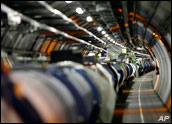
The Large Hadron Collider created by CERN, the European Organization for Nuclear Research, officially became the world's highest-energy particle accelerator on Monday.
The enormous facility has sent two beams of protons shooting through its ring at 1.18 teraelectronvolts (TeV). It happened 10 days after scientists started up the collider again following a one-year hiatus due to technical problems.
The previous record of 0.98 TeV was set by the U.S. Fermi National Accelerator Laboratory's Tevatron collider in 2001.
The LHC is designed to smash proton beams into one another at 7 TeV to help simulate the sort of conditions present just after the Big Bang. In doing this, scientists hope to answer some of the most fundamental questions in physics. These include proving whether or not the Higgs boson exists.
Knocking on Heaven's Door
Built in a circular tunnel 27 km in circumference and buried about 50 to 75 meters underground, the LHC is designed to bash together two beams of protons or heavy ions moving at 99.999999 percent of the speed of light. The beams rotate in opposite directions.
That cosmic train wreck will let scientists get a peek at what happened microseconds after the Big Bang theoretically created the universe. How does it do this? High-energy particle accelerators can, in effect, act as microscopes that examine fundamental physics at distances a hundredth or a thousandth of the size of a proton, according to Penn State University physics professor John Collins.
Hunting the Higgs Boson
One of the questions the LHC was built to answer is, does the Higgs boson really exist? A boson is a subatomic particle that obeys Bose-Einstein statistics. Scientists have observed bosons, and, using the Standard Model, have predicted that the Higgs boson exists, but they have not yet observed one.
The Standard Model of particle physics is a theory of three of the four known physical fundamental interactions and the elementary particles taking part in these interactions. These particles make up all visible matter in the universe. The Standard Model falls short of being a complete theory of fundamental interactions because it does not include gravitation, dark matter, or dark energy.
A Higgs boson, if it exists, would explain the origin of mass in the universe. "An elaboration of the Standard Model of particle physics suggests there's another force in the universe which confers mass upon all basic particles," explained Phillip Schewe, a spokesperson for the American Institute of Physics. "A very basic question that hasn't yet been answered is, why do quarks and other known particles have the properties they do, such as mass and specific charges?"
Why is a Higgs boson different from other bosons? This boson is really a precipitation of the Higgs field, which permeates the universe, Schewe told TechNewsWorld. "Just as moisture in the air could precipitate as a raindrop, so can the Higgs field precipitate as a particle," he explained. That particle would be the Higgs boson.
While the Higgs boson has mass, it is very unstable as a particle, so it cannot easily be observed in a laboratory, Schewe said. It has to be artificially created in order to be observed and, even then, it will exist for a very short time. To create Higgs bosons, the LHC needs to smash together particle beams at pretty close to the speed of light. "You need lots of energy for this because these particles are so heavy," Schewe explained.
When the beams are smashed together, the resulting energy is converted into a very small fireball that manifests briefly as a particle which decays rapidly into a daughter particle. The daughter particle has a longer life, but it's still very short. "It may be the fourth- or fifth-generation daughter particle that is stable enough to observe," Schewe said.
If everything goes according to researchers' plans, the LHC will smash proton beams together for the rest of the year to calibrate its equipment. The first proper physics results are expected to emerge in the first quarter of next year.















 Loading ...



























Hunting the Higgs Boson
-break – "Scientists have observed bosons, and, using the Standard Model, have predicted that the Higgs boson exists, but they have not yet observed one."
Tricky little buggers those bosons: Now you see them; now you don’t.