
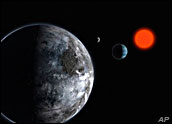
A European team of astronomers has discovered what may be the most Earth-like planet outside of our solar system, potentially capable of having liquid water and extraterrestrial life.
The planet, Gliese 581 c, named after the red dwarf star Gliese 581 that it orbits every 13 days, is about 20.5 light years away from Earth, the scientists report. Located in the constellation Libra, Gliese 581 is about one-third the mass of the sun and produces sunshine, so to speak, at least 50 times fainter than light emitted from our own star.
Because the new planet is much closer to its host star than the Earth is to the sun — 14 times closer — the planet may be capable of harboring life.
“We have estimated that the mean temperature of this super-Earth lies between zero and 40 degrees Celsius, and water would thus be liquid,” explained Stphane Udry, from the Geneva Observatory (Switzerland) the lead author of the paper reporting the result.
“Moreover, its radius should be only 1.5 times the Earth’s radius, and models predict that the planet should be either rocky — like our Earth — or fully covered with oceans,” he added.
Water Is Key
“Liquid water is critical to life as we know it,” noted Xavier Delfosse, a member of the discovery team from Grenoble University in France. “Because of its temperature and relative proximity, this planet will most probably be a very important target of the future space missions dedicated to the search for extra-terrestrial life. On the treasure map of the Universe, one would be tempted to mark this planet with an X.”
“From my perspective — that of an astrobiologist — the discovery of a massive, rocky planet with surface temperatures suitable for habitability is as dramatic as the discovery of the first extrasolar planets more than a decade ago,” Edward D. Young told TechNewsWorld. Young is a professor of Earth and space sciences at the University of California in Los Angeles.
“It shows that not only is our solar system likely to be ‘normal’ in having planets around a central star, but it may also be typical in having rocky planets, as opposed to gas giants, orbiting a central star,” he said. “In other words, the odds that there are habitable planets elsewhere in the galaxy goes up dramatically upon finding even just one example beyond our solar system.”
No Pictures Yet
The astronomers found the new planet by using a spectrograph called High Accuracy Radial Velocity for Planetary Searcher (HARPS), which is located on the ESO 3.6-m telescope at La Silla, Chile. HARPS is able to measure velocities with a precision better than one meter per second and is used to detect exoplanets, which are planets located outside of our solar system.
By measuring movement of the host star, the discovery team was able to detect the presence of a planet within a certain size range — at least five times the mass of the Earth, though it could also possibly be larger.
The discovery is certainly exciting, but it is not definitive.
“The information we have gathered is limited, and even the information we can gather for a very long time will stay limited, and it’s in no way clear to me that this is a planet that is indeed suitable for life,” Neville Woolf told TechNewsWorld. Woolf is a University of Arizona professor of astronomy, astronomer of Steward Observatory, and principle investigator of the University of Arizona team of the interdisciplinary NASA Astrobiology Institute (NAI).
“Gliese 581 c is more massive than Earth, which likely means that it has a thicker atmosphere, so if we ever get to actually image it, we’ll have real difficulty because it’s unlikely that we’ll be able to see to the surface,” he said.
The NAI is made up of hundreds of team members, all of which work to uncover the mystery of life in the universe. Despite the enthusiasm of the Gliese 581 c discovery team, it’s unlikely that the new planet will provide proof of life any time soon.
The Next Step
What’s next? How would we find more definitive indicators of life on Gliese 581 c?
“We won’t on this one; it’s just a signpost on the way [to finding life in the universe],” Woolf explained. “It will have some further work done, and then it will probably lie fallow for twenty or thirty years while technologies develop until we can see things.”
Seeing the planet is quite a challenge, it turns out. Only a tiny percentage of planets that are far away from Earth can be seen — the trick is to find and view a planet as it passes between the Earth and its host star, which may allow an astronomer to accurately measure its diameter and possibly discern more about the makeup of the planet.
Despite the challenges, the discovery team is pressing on.
“The first step is to check whether we are lucky enough that the orientation is right for the planet to transit across its star,” Thierry Forveille, a member of the discovery team and astronomer with the Laboratoire d’Astrophysique de Grenoble in France, told TechNewsWorld. “If it does — the probability is a small percentage — we immediately get the radius of the planet and further measurements can look for absorption from its atmosphere and for light from the planet itself.”
“If it it does not, further followup is probably limited to looking for additional planets in the system, until specialized instruments and satellites come online in five to 10 years and can handle the huge luminosity contrast between the star and the planet,” he added.


















 Loading ...
























Excellent! Frozen world of steamy ocean, I’d like to go.
See my blog comments on this at:
http://angrylabrat.blogspot.com/2007/04/neo-earth.html