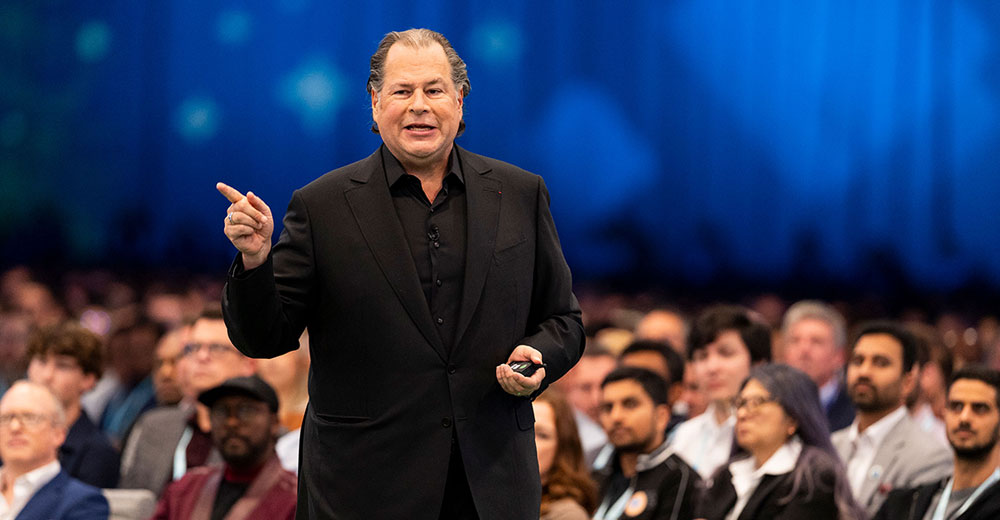
Salesforce used Dreamforce 2025 to do more than launch products. It declared a philosophical shift in how companies will operate -- what Salesforce’s longtime CEO Marc Benioff called the “agentic enterprise.”
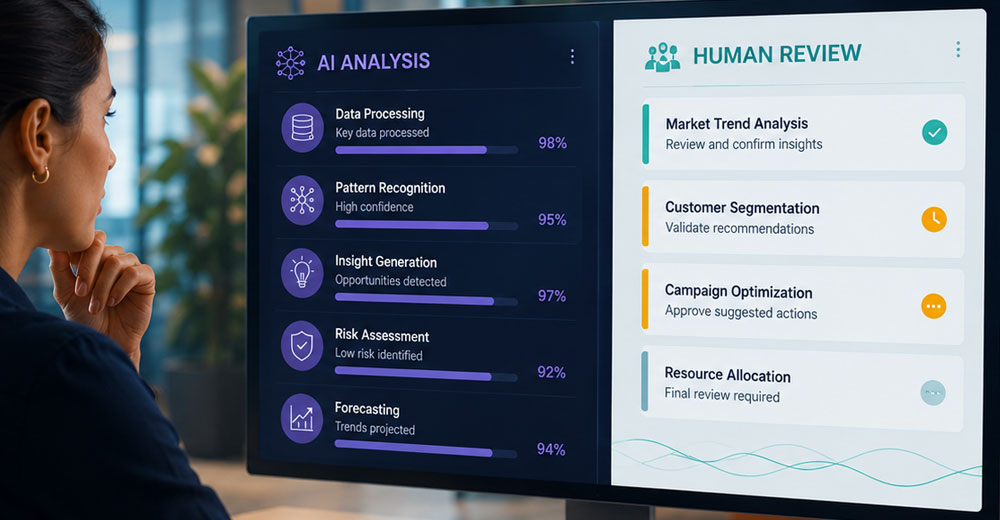
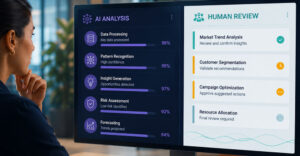
At its core, this is Salesforce’s vision for a world where AI agents not only assist humans but also work alongside them in every workflow, every function, and every customer touchpoint. Rather than replacing sales teams, Salesforce presents AI as an amplifier of human capability.
Benioff’s opening words made the point clear: “AI doesn’t care. But we do. The real miracle isn’t building machines that think like us. It’s building an enterprise where people can become everything they’re capable of being.”
That framing truly matters. It distances Salesforce from the dystopian narrative that AI automates people out of jobs. Instead, it positions AI as a human enabler, freeing employees from repetitive tasks so they can focus on strategy, relationships, and creativity.
Salesforce refers to this fusion of humans and AI as “agentic,” and it’s building the infrastructure to make it a reality.
Agentforce 360: A Unified AI Platform
The centerpiece of Dreamforce 2025 was the unveiling of Agentforce 360, a fully unified AI layer built across all Salesforce applications — Sales, Service, Marketing, Commerce, Slack, Tableau, and even ITSM.
Benioff described it as “the next revolution after cloud, mobile, and social — the agentic AI revolution.”
Agentforce 360 isn’t just another automation tool. It’s an ecosystem of intelligent agents — what Salesforce calls “Agentforce” — that can interpret context, access data from multiple systems, and act autonomously. The platform combines natural language with deterministic logic through a new feature called Agent Script, enabling enterprises to design predictable and auditable AI workflows.
Salesforce EVP of Product and Industries Marketing, Patrick Stokes, demonstrated this with Agentforce Vibes, a developer tool that lets anyone “vibe code” applications by simply describing what they want to build. In minutes, Stokes created a real-time Dreamforce command center dashboard without writing a single line of code. He told the audience, “For the first time, our people, our AI, our business, and our ideas all speak the same language.”
That statement captures Salesforce’s broader goal — to make AI accessible not only to data scientists but to sales reps, marketers, and service teams. The company wants every employee to be able to build, customize, and deploy their own digital co-worker.
Turning Sales Teams Into Strategic Orchestrators
Salesforce’s pitch to sales organizations was simple: AI will turn selling from manual execution into intelligent orchestration.
Benioff noted that over the past two decades, Salesforce has digitized the sales process — pipeline tracking, CRM, lead scoring, and account management. But those tools have often overwhelmed sales teams with data instead of empowering them.
The agentic model promises that AI will now interpret that data, summarize customer context, recommend subsequent actions, and even initiate conversations.
During the keynotes, several examples illustrated how this might work:
- Williams-Sonoma built “Olive,” an AI sous-chef that guides customers through product discovery and purchase decisions. However, behind the scenes, Olive’s intelligence also supports Salesforce’s sales teams by identifying new opportunities, surfacing potential upsells, and predicting churn risk.
- Pandora created “Gemma,” an AI personal shopper that operates across chat, web, and voice. Sales associates can pick up customer interactions mid-conversation because Agentforce synchronizes every channel — what Salesforce calls “one agent, one interaction, one experience.”
This convergence underpins Salesforce’s argument for an AI-enabled sales strategy. The mechanics of the funnel no longer burden sales reps. Instead, they’re elevated into strategic advisors who spend more time nurturing relationships and less time toggling between systems.
Benioff called this “humans and agents driving customer success together.”
It’s an evolution of Salesforce’s original CRM promise, from managing relationships to activating them through AI-driven insight.
From Productivity to Purpose
One subtle yet essential theme running through both keynotes was the concept of purpose. Salesforce didn’t just talk about speed or efficiency. It spoke of meaning.
Benioff reflected that many people feel disillusioned by the grind of modern work — buried in data entry, inboxes, and dashboards. AI, in his telling, restores time and energy for higher-value contributions. “More time to solve. More energy to connect. More humanity in the loop,” he said.
This emotional framing aligns with Salesforce’s culture of “Ohana” and its long-standing 1-1-1 philanthropy model. It also serves a strategic purpose: while competitors like Microsoft and Google emphasize raw AI power, Salesforce differentiates through its narrative of trust, ethics, and human-centric design.
That trust theme was reinforced repeatedly. The company positioned Einstein Trust Layer as the safety net that ensures customer data never leaves Salesforce’s secure environment. The new Agent Script feature also reflects this focus on control, providing admins with deterministic guardrails so AI doesn’t “hallucinate” or make rogue decisions.
For enterprise sales teams handling sensitive customer data, that’s a persuasive argument. AI may be powerful, but without trust and governance, it’s unusable. Salesforce wants to be the company that delivers both.
Voice AI and Context in Sales
Dreamforce 2025 also introduced Agentforce Voice, giving AI agents a conversational layer across the contact center and sales workflows.
In one demo, an AI agent handled customer inquiries through natural dialogue, understood product history, and scheduled appointments, all while syncing with Salesforce data. The magic wasn’t just in voice recognition; it was in context continuity.
Benioff emphasized that context is the secret sauce. “You don’t have your data, you don’t have your context,” he said. Agentforce 360 unifies that context across every channel — voice, chat, email, or field service — ensuring that the AI knows the customer’s journey end-to-end.
For sales representatives, this means they can join or hand off a conversation without losing the history. Imagine an inside sales agent who’s briefed automatically on what an AI discussed with a prospect, what pain points emerged, and which proposal templates were most effective. Instead of scrambling through CRM notes, the rep can walk into the next call fully informed.
It’s easy to see how that kind of continuity could lift close rates and improve customer satisfaction.
Human-AI Feedback Loop
Across both keynotes, Salesforce executives emphasized that AI’s true power lies in the feedback loops between humans and agents.
Every time an agent answers a question, generates a campaign, or drafts a proposal, it feeds more intelligence into the system. Over time, the agent learns from the human’s edits, decisions, and tone. That feedback loop, what Salesforce calls “agentic learning”, gradually improves both sides of the equation.
This approach is especially transformative for sales organizations where training and ramp-up time can be expensive. An AI agent that learns the company’s top-performing sales techniques and embeds them into future interactions can scale expertise across an entire organization.
As Benioff framed it, “We’ve already seen over a million customer service requests handled by Agentforce. That’s a million times our people were empowered to drive greater value.”
The implicit message: imagine what happens when that scale reaches sales, marketing, and beyond.
Anthropic, Trust, and the Ecosystem Play
While most of the spotlight was on Agentforce, Salesforce’s follow-up announcement with Anthropic earlier in the week signaled something bigger: a broadening ecosystem strategy.
Salesforce will now expand Anthropic’s Claude models deeper into regulated industries, such as financial services, healthcare, and government, all integrated through its Einstein AI Platform.
This partnership matters for two reasons.
First, it cements Salesforce’s neutral-model approach. Rather than tying customers to a single LLM vendor, Salesforce is building an “open model orchestration layer” that allows enterprises to use OpenAI, Anthropic, or their own custom models, depending on the sensitivity of the data.
Second, it provides Salesforce with a credible answer to the governance question that has hindered the adoption of generative AI in highly regulated sectors. By combining Anthropic’s “Constitutional AI” framework with Salesforce’s trust architecture, the company is effectively saying: “We can bring AI to your industry without violating your compliance boundaries.”
That’s a powerful message to large B2B sales organizations, especially those in finance, pharma, and insurance, that have hesitated to deploy AI due to risk concerns.
Realistic Optimism
Dreamforce keynotes have always been part product showcase, part revival meeting. This year was no different. The energy in San Francisco’s Moscone Center was unmistakable: part excitement, part relief.
The relief stems from a sense that Salesforce has found its footing with AI after a period of uncertainty. The company was late to the generative AI race in 2023, but it’s now leveraging its greatest asset: decades of customer data and workflow expertise.
By framing AI as “agentic,” a term still emerging in the mainstream, Salesforce has carved out its own linguistic niche, one that seamlessly blends technology with humanity. It’s a story that resonates with both IT buyers and front-line sales leaders.
Still, challenges remain. Execution will depend on how well Salesforce can deliver on seamless data integration, reduce AI hallucinations, and manage cost at scale. Competitors like Microsoft (with Copilot) and HubSpot (with Sales Hub AI) are racing toward the same goal, aiming to make sellers more productive through context-aware automation.
Salesforce’s differentiator will likely be its depth — the completeness of its CRM, data cloud, and now its agent layer.
Will Salesforce Define the Agentic Future of Sales?
Dreamforce 2025 painted a bold vision of the future of sales: one where every rep has an intelligent partner that listens, learns, and acts.
Sales teams won’t be replaced. They’ll be augmented and equipped with agents that prepare meetings, qualify leads, update records, and surface insights in real-time. The mundane disappears. The strategic re-emerges.
As Benioff summed it up, “AI, when built with trust, elevates your people. It helps them move faster, think deeper, and connect more meaningfully.”
If Salesforce can deliver on that promise, the agentic enterprise may indeed become the next great evolution of the modern sales organization, not a story of machines taking over, but of people finally getting back to what makes them irreplaceable.














 Loading ...