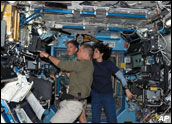
After working overnight to try to restore two failed computers aboard the international space station (ISS) to full operation, flight controllers have made little progress in identifying or fixing the problem.
Operating on the theory that the pair of new solar arrays being installed on the starboard side of the station might be creating electrical interference that's at the root of the problem, crew members first checked the power with an oscilloscope, which indicated the power quality was fine, ISS program manager Mike Suffredini said.
Just in case, the crew then tried disconnecting the power cable between the new arrays and the modules in which the computers are located, but "there was no big impact," Bill Jeffs, a NASA spokesperson, told TechNewsWorld.
On Friday morning, the computers could not be restarted.
No Easy Answers
"They've ruled out all the easy answers," James Oberg, a retired rocket scientist who is now an author and consultant, told TechNewsWorld. "They'll try some additional power sources tomorrow, but in the meantime they're getting serious about ways to fly for an extended time without the computers. They're probably not going to be able to fix the computers before the shuttle leaves."
The problems arose Wednesday while crew members were working to retract a solar array as part of their scheduled mission. Together, the computers affected control orientation of the space station along with supply of oxygen and water to the crew.
"The crew is absolutely not at risk," Suffredini said. "We're in a good configuration for life support, with plenty of oxygen."
As part of the original plan for Friday's 6 1/2-hour space walk, Mission Specialist Jim Reilly will also be installing a hydrogen vent for a new oxygen generation system that can be deployed as well.
Possible Solutions
In the meantime, crew have determined that a secondary power supply on at least one of the computers may have failed, and are investigating options for remedying that problem.
Flight controllers are also investigating the possibility of removing a connector on the truss with the new solar arrays, which an analysis of the problem's time line seemed to suggest may be involved, Suffredini said. The connector is for a future part, but is not currently needed, he explained.
They will also investigate the possibility of powering the computers directly from the U.S. side of the space station, without going through the solar arrays.
Finally, because electrical interference could still be part of the problem, the crew are also looking at options to desensitize the computers to the environment, Suffredini said.
Shuttle's Departure
The biggest challenge now, Suffredini said, is to maintain the space station's attitude. It can maintain its position for a few months without correcting its flight, but the departure of the shuttle on Wednesday could pose a challenge, he said, as would any kind of maneuvers in the future.
Over the next few days, the team will be investigating ways to allow the space station's control moment gyros to take over after the shuttle departs, he noted.
Meanwhile, today's space walk will progress as planned, Suffredini added, with work to be done repairing the shuttle's thermal blanket and retracting the P6 array.
Solar Winds
Interference from the new solar arrays is definitely "not an impossibility," Paul Czysz, professor emeritus of aerospace engineering at St. Louis University, told TechNewsWorld.
Additional solar arrays on the space station also create more drag on the solar winds, he added, making regular attitude boosts essential. Loss of the computers controlling those reboosts would simply mean the function has to be regularly checked and performed manually, Czysz explained.
Overall, though, the space station was designed to accommodate a staff of 21, so life support for just three regular staff should not be any undue burden on the station's systems, he pointed out.
Outside Help
If interference from the solar arrays is the problem, one solution could involve placing the computers in a "Farraday box" made of copper to isolate them from the noise, he added.
In the long run, if the computers can't be fixed, "the most pragmatic thing to do is let the Russians send up another Soyuz rocket and capsule with new technology and a repair technician," Czysz said.
Under current rules, that could be a problem, because NASA limits the number of such Soyuz capsules docked at the station to just one, and the current ISS staff members' capsule is already there.
Next Progress Launch
NASA would have to make an exception to that rule to get the computers replaced. "Somebody at NASA with enough intestinal fortitude needs to say, 'we need to save the space station,' and allow a second Soyuz up there," Czysz explained.
Meanwhile, the next Progress launch has been moved up from Aug. 8 to July 23, Suffredini announced, though it may be moved back again if the computers are not repaired by then. The Progress could be used to bring additional parts and computers, if needed.












 Loading ...