
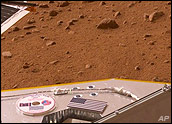
Scientists on Friday confirmed that NASA’s Phoenix Mars Lander has uncovered ice in the sandy soil of the red planet.
“It is with great pride and a lot of joy that I announce today that we have found proof that this hard bright material is really water ice and not some other substance,” said Phoenix Principal Investigator Peter Smith of the University of Arizona at Tucson, during a Friday news briefing.
Though the scientists had initially thought the chunks of bright material exposed by digging might be salt, the chunks had disappeared a few days later, suggesting that vaporization had occurred. The disappearing chunks also could not have been carbon-dioxide ice because at the local temperatures that material would not have been stable for even one day as a solid, the researchers said.
“These latest developments are a major accomplishment and validation of the Mars Program’s ‘follow-the-water’ exploration framework,” said Doug McCuistion, director of NASA’s Mars Program.
More Testing
Phoenix landed on May 25 for a Mars surface mission planned to last for three months as part of an effort to determine whether the local environment just below the surface of far-northern Mars has ever been favorable for microbial life.
While the disappearing chunks were in a trench to the northwest of the lander, another hard material — possibly more ice, but darker in color than the first batch — has been detected in a second trench, to the northeast of the lander.
Scientists plan next to have Phoenix collect and analyze surface soil from a third trench near the second one, and later to mechanically probe and sample the hard layer.
“We have in our ice-attack arsenal backhoeing, scraping and rasping, and we’ll try all of these,” said Ray Arvidson of Washington University in St. Louis, lead scientist for Phoenix’s Robotic Arm.
The Phoenix mission is led by Smith with project management at NASA’s Jet Propulsion Laboratory (JPL) and development partnership at Lockheed Martin in Denver. International contributions come from the Canadian Space Agency; the University of Neuchatel, Switzerland; the universities of Copenhagen and Aarhus, Denmark; Max Planck Institute, Germany; and the Finnish Meteorological Institute.
‘Good News for Life’
Of course, the presence of ice alone doesn’t positively indicate the past or current presence of life. Other key factors are whether the water ever becomes available as a liquid and whether organic compounds are present that could provide chemical building blocks and energy for life, the researchers noted.
“The truth we’re looking for is not just looking at ice,” Smith explained. “It is in finding out the minerals, chemicals and hopefully the organic materials associated with these discoveries.”
Indeed, water is actually “a very common thing,” Heather Knutson, a graduate student and researcher in astronomy at Harvard University, told TechNewsWorld. “We see it all over the universe, on all kinds of different planets in our own and other solar systems. That’s good news for life,” she added.
Tenuous Connection
“It is very exciting,” Mario Livio, a senior astrophysicist with the Space Telescope Science Institute, told TechNewsWorld. “I would not use the word ‘surprising’ because I believe that scientists for a long time have suspected there is water ice underneath the surface.”
Whether the presence of water means life has also been there, however, is less certain.
“The relation of this to life is still tenuous,” Livio said.
“Although we believe that on Earth, at least, the development of life did require liquid water, water itself does not create life,” he explained. “What water does is create a ‘primordial soup’ where all different organic molecules are able to combine and form larger chains and complex molecules.”
Necessary but Not Sufficient
We don’t yet know whether all of those other molecules exist on Mars, he added, nor whether there is currently liquid water. “There is evidence of it having been there in the past, but what they found now is really only in the form of ice,” he noted.
In short, then, water is “an absolutely necessary step toward life, but it’s definitely not a sufficient one,” Livio concluded. “It’s a step in that direction.”


















 Loading ...






















There are more than water and ice in mars, inthe previous year, we disvcovered transparent tube like pipes running in and out from the surface of mars to underground of mars..
this was a bigs discovery, and there was a conference meeting called for this but it was ignored due to less proof,
but does the telescopic images is not proof enough??
i guess till we get in contact of the the location or Extraterristrial itself by NASA, so called equipment.. our/yours discovery wont mean anything..
but one thing for sure, other than water and ice,..here is life more life waiting to be discovered.
till then listen to some music and enjoy life.
http://www.thedesirapper.com