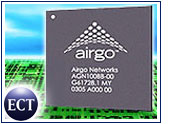
Wireless startup Airgo -- a company that consists of some of the wireless industry's most prominent pioneers -- announced it is sampling a new WiFi chipset that promises to double the range and data throughput rates of wireless local area networks (WLANs).
Palo Alto, California-based Airgo said its AGN100 WiFi chipset, for use in 802.11 wireless networks, takes advantage of multiple-antenna technology to increase existing WiFi rates to 108 Mbps and extend current WiFi range to as much as six times that of competing chipsets.
Yankee Group analyst Sarah Kim told TechNewsWorld that while WLAN applications are the real key to advances and adoption, the Airgo chipset marks a new page for wireless networks.
"There's been no big shift yet [in wireless technology], and if this technology does what it is supposed to do, you're talking about a pretty significant paradigm shift at the hardware level," Kim said.
Widening WiFi
Airgo -- a company that includes 802.11 patent holder and pioneer Richard van Nee as well as other industry players who have been partly responsible for Apple's AirPort and Intel's Centrino chipset -- said its new chipset addresses several key WiFi issues, including spotty coverage, limited range, insufficient speeds, weak security and confusing standards.
The company said the improved performance will reduce the cost and complexity of WLAN business infrastructure -- mainly by requiring fewer access points -- and pave the way for new wireless applications, such as high-definition video over wireless connections.
Referring to hardware competition from other small companies, such as Acton, Massachusetts-based Engim, Kim said the Airgo technology is designed to create value in the industry by enabling wireless delivery of high-end applications.
Advanced Antenna
Claiming its chipset can extend WiFi range up to two to six times that of current WLAN chipsets, Airgo credited its multiple-antenna system for the improvements. The reception technology, called multiple-input multiple-output (MIMO), involves use of multiple antennae to send and receive signals and algorithms to process them for improved reception.
A MIMO antenna has long been considered the pinnacle of wireless-channel optimization. The MIMO concept received much industry attention in the early 1990s when it came out of research at Bell Labs, but it has always been too bulky to be deployed commercially -- at least until Airgo put it on a chip.
Farpoint Group principal Craig Mathias said the use of MIMO, which he called "likely the only viable path to significantly improved range and throughput in WLAN systems both today and in the future," brings a new class of performance to wireless LANs.
Airgo expects to have AGN100 products on store shelves by the end of 2003. The company touted its overhaul of the entire wireless network system, which has resulted in a chipset with built-in support for security, quality of service, voice over IP and roaming capabilities.
Airgo spokesperson Carl Temme told TechNewsWorld that the new chipset incorporates the latest WiFi security standard, known as 802.11i, as well as security methods typically used in wired networks. "[The new chipset] gives you all of the security you need and even more security than a wired network," Temme said.
In Search of Apps
The Yankee Group's Kim told TechNewsWorld that although the Airgo chipset represents a new hardware approach to WLAN technology, enterprise adoption of wireless networks is more dependent on applications.
"Until there's a willingness by enterprises to explore applications and ways to deliver wireless to their customers, [WLAN adoption] certainly isn't going to be affected by better range or rates," she said.
She added that despite industry-wide software improvements and the sale of WLAN packages, the Airgo chipset marks the first real change to the fundamental technology of WiFi networks.
Airgo's hardware ultimately might help differentiate between home and enterprise wireless technologies, which have remained similar enough that many businesses currently deploy cheaper home equipment at the office.
"It gets us one step closer to the self-healing, self-managing, ad-hoc architecture that has redundancy and network performance and is closer to the wireline experience we're used to," Kim said.
The company has not disclosed pricing, but founder and CEO Greg Raleigh said Airgo's solution will entail a US$20 to $50 street price premium over existing WLAN designs.














 Loading ...